Storytellers are Deviants
Jan 20, 2026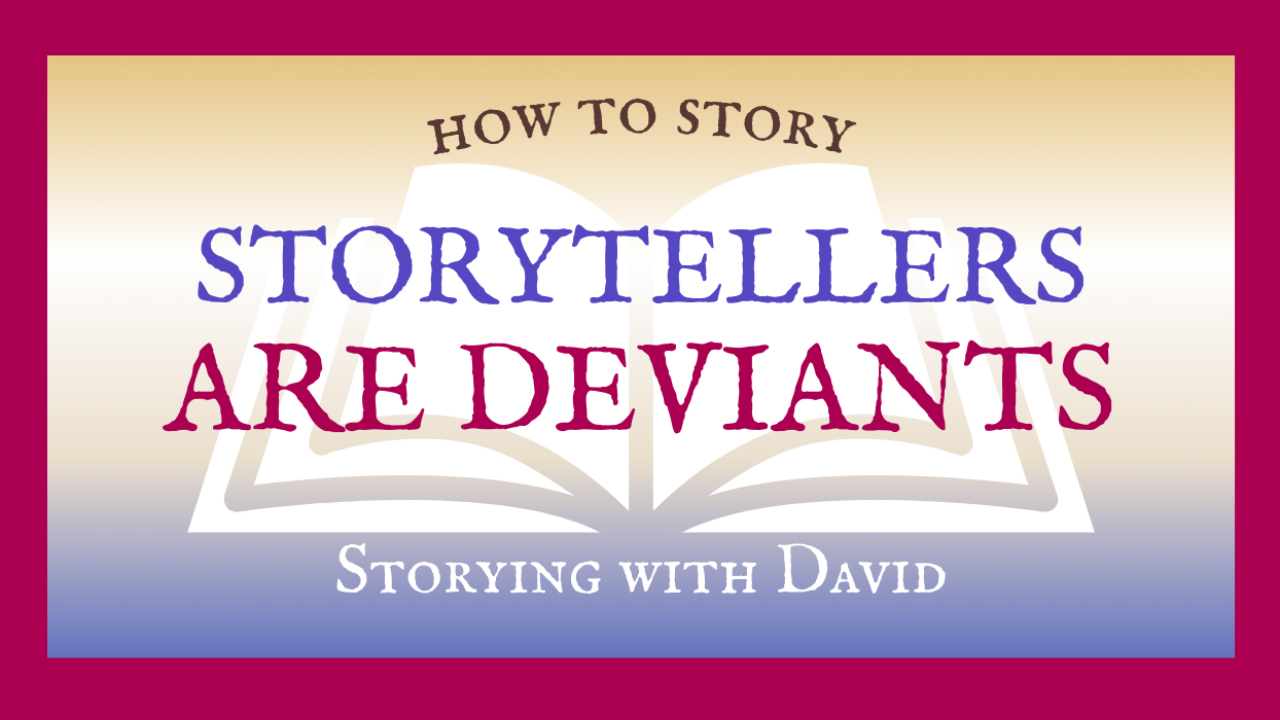
This post is intended for one person in my life, but the approach is offered here for all of us. Especially for those who are authentically wondering why progress often seems to move so very slowly.

Let’s start with this image.
Imagine someone in your life driving. Put them behind the wheel. See them driving and ask yourself, “Are they driving away from something or towards something?”
You might say a little of both and of course you are not wrong, but for each individual, you will likely lean in one of those two directions: forward or back.
This is a binary that isn’t easy to translate politically or psychologically, but it is a thing. It is a real thing. As you can see from the image above, there is a blue side, a red side and a strip of white in between. I did not choose blue and red as a representation of political party—I chose it as connected to directional storytelling. The image shows the direction of blue, the direction of red and identifies the point in between. This point is transformation.
Let me unpack the image.
When we drive away from something, we actually go backwards.
Literally. Our point of view is trained on what happened and how we are going to respond. “I am going to make sure that never happens again,” or “I won’t be like my mother,” or “This needs to change.” These are all strong positions that welcome change, and they are all trained on what is behind us. What we are driving away from. This is blue. We don’t necessarily know where we are going, but we know what we don’t want. We know what we want to change.
When we drive toward something, we do so without caring where we are coming from.
The past is not here, not present—and when moments from the past try to intercede, we will gladly change the past to accommodate what is truly important to us: where we are going. We want something. We will have something. It will happen. And if the past tries to correct us, we will correct the past. It sounds ruthless to some of us because many of us highly value the past. We are authentically blue. But those of us who are authentically red might say, “If you want something to happen, you make it happen. No excuses.”
This binary is not “right” or “wrong” it is simply forward or back.
And like any binary, it is seldom one or the other. As noted, we are often a mix of both, and can be more red in one part of our life and blue in the other.
So what does this have to do with “Positive Deviance?”
PD is the white part. The moment of transition.
The concept is associated with behavioral and social change and can most often be found in education, healthcare and business. It was named in the 1970s by Jerry and Monique Sternin with their work in Vietnam aimed toward helping malnourished children. I received an image from my channeling work that helps me understand the idea and adapt it to Restorative Storytelling: that of a new branch forming from a tree.

In this image, a bud senses nourishing light in a particular direction, and it forms a branch. It deviates from the rest of the tree and moves toward the light. It moves, in that moment, from blue to red. It is still connected to the tree, but its attention is entirely toward the opportunities of the light. It might scorn or “restory” the tree in order to better reach the light, but the light is what is important to that branch. And even if this branch badmouths the tree, the tree knows the branch will positively benefit the entirety of the tree because it is still connected. It will still bring light to the tree. The branch has become a positive deviant.
All of us have this.
We all have our tree—where we come from, our past, our support, our past, the history and society we live in right now. This is our blue.
And the moment we have our white light experience, we see where we wish to go. We train on the light. We stop thinking about the past and deviate from it. We branch in a new direction with a single focus: the light. We deviate and charge forward. We benefit the society by doing so, even if we shake our fist at it or change the story. Its ok. We do what we must do to protect the light. We go red.
I’m not saying you have to do this.
But I am saying that this exists in most of our favorite stories. We all know the moments in which our favorite characters deviate and move from blue to red. We are taught that this is good and productive and the way to go. We look for transformation and ultimate success—often financial or romantic or we gain some fame. We are trained to value red—but we forget that we always have both. The blue connects us to the tree. It is reality. We are always connected to where we come from.
But the moment of positive deviation asks that we momentarily forget the blue and go full red for a while.
This will make a new branch that will ultimately serve the tree, serve the blue, serve those in need.
It is a choice, and it isn’t for everyone.
But I believe it is what my friend wants. And possibly you as well.
Join a community of Storytellers and receive lots of free tools and courses. I'd love to meet you!
