A Framework for Collaborative Storytelling
Sep 13, 2026
Oh, mother earth, your comfort is great, your arms never withhold. It has saved my life to know this.”
— Mary Oliver
“Look down from above on the countless herds of men and their countless solemnities, and the infinitely varied voyaging in storms and calms, and the differences among those who are born, who live together, and die.”
— Marcus Aurelias
“Being a candle is not easy. In order to give light one must first burn.”
— Rumi
“Water does not resist. Water flows.
When you plunge your hand into it, all you feel is a caress..”
— Margaret Atwood
The simple framework for Collaborative Storytelling returns to the four directions of down, up, forward, and back.
Now we add another four-ness to the mix: four ways to collaborate dialogically. This is a framework that is designed to connect with anyone, even those that have trouble connecting, or listening, or being with other people. We live in an age of heightened anxiety, over stimulation, stress, fatigue, and very high expectations of ourselves and others. We have a hard time slowing down. We have a hard time listening, and we have a hard time being patient long enough to build relationships. We can look at the four ways to use collaborative storytelling at first by highlighting the extremes. These four extremes have varying levels of loudness and subtlety, but we will start with the brightest colors. We have felt each of these under certain conditions or chapters in our lives.
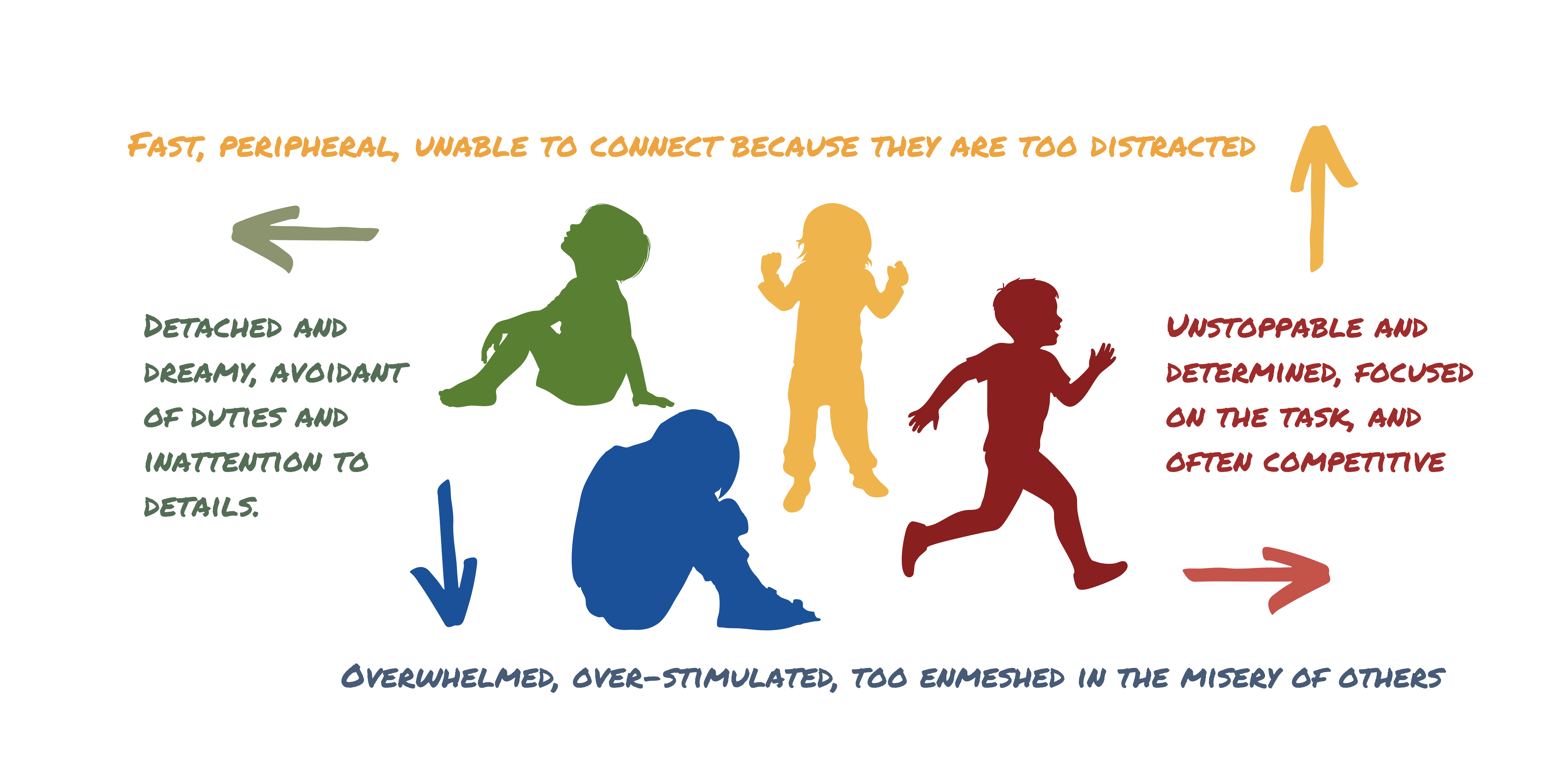
Down: Overwhelmed, depressed, over-stimulated, too enmeshed in the misery of others and the world, and too sensitive to do anything about it.
Those in extreme “down” can feel the need to shut out the world and focus exclusively on their own needs, often finding even that is too much. They need quiet, solitude, trust only a few people, and will collapse in a stimulating environment or around people with disruptive energy.
Up: Fast, peripheral, not able to connect with others because they are too distracted.
Detached and have lots of dispersed energy that swings between fanatic zeal and exhaustion. Spread in all directions and unable to get anything done. Usually in their own head and not able to be still long enough to connect and have relationships.
Forward: Unstoppable and determined, focused on the task, and often competitive.
Need to know the rules and will demand others follow them while giving themselves a reprieve. Can be demanding, controlling, tyrannical and angry. There is an urgency to everything they do.
Back: Detached and dreamy, avoidant of duties and inattention to details.
They seem lazy, irresponsible and “out of it”. Don’t want to be rushed and resistant to any demands. They want to be left alone to do what they want in their own time. Feel misunderstood but have a hard time explaining what is going on.
Collaborative Storytelling does not pathologize or diagnose beyond observing the behavior of the listener or collaborator. The storyteller uses the tools of Restorative Storyteller and gauges their own presence, gesture, vocality to assess their listener, and then tinkers with the four listening types. They set an intention for the story and proceed to empathize with the listener, use the protocol of Intuitive Storytelling to collect useful images, and land on a general sense of what is happening. Meeting the listener where they are, the storyteller can then use any of the energetic “substances” explored in the next several mini-books to align with the listener and launch a transformative collaboration.
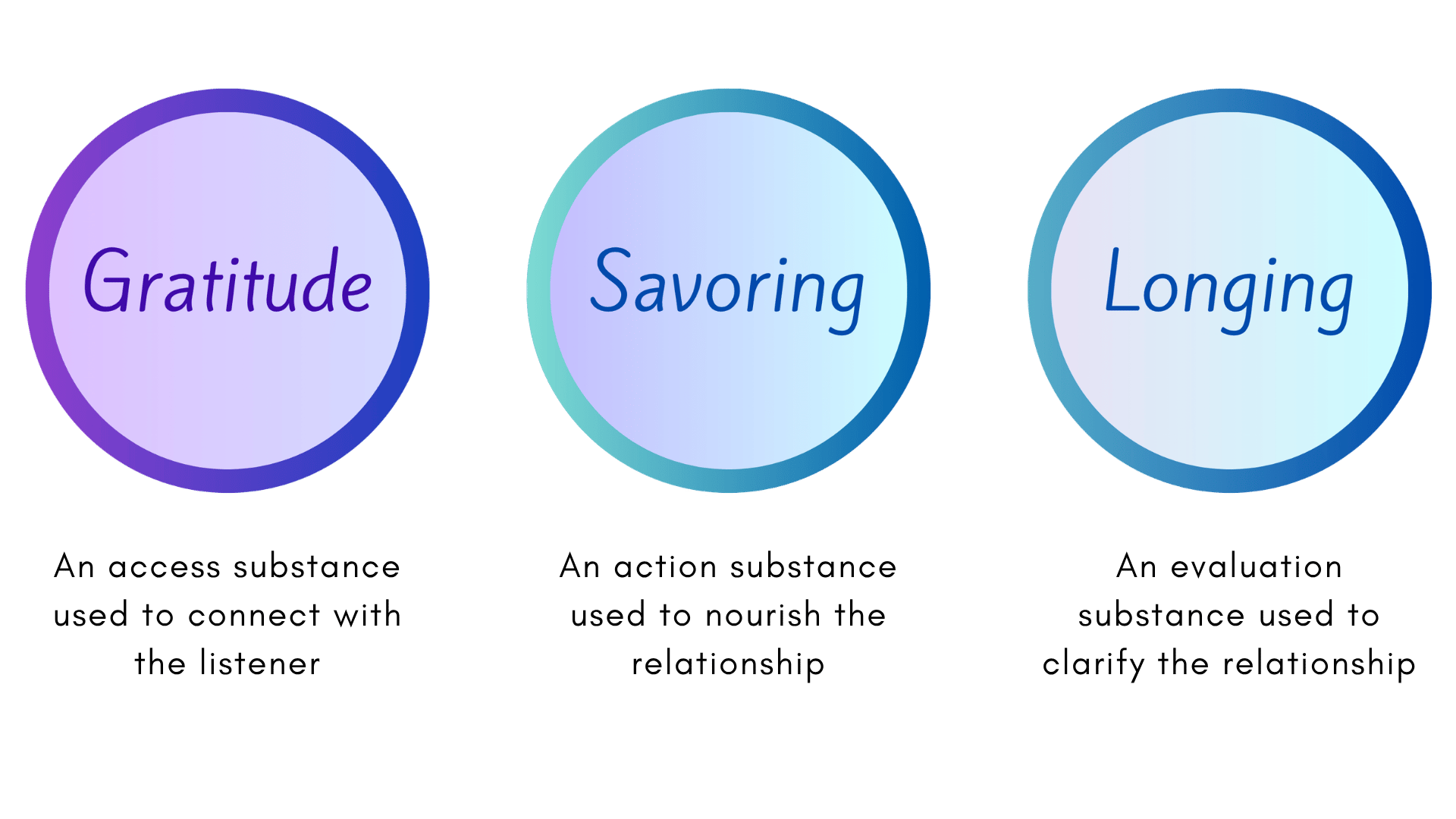
As an introduction to these substances, you can imagine what the shapes described in an earlier post might feel like. When a particular story shape lands hard in our bodies, we can feel the direction of down. This can manifest in a variety of sadnesses and other heavy sensations. One of the energetic substances that can meet sadness is the substance of gratitude. Wait, gratitude as a substance? How does that work? Roll with me for now, and know that the next mini-book will take up the substance of gratitude, as well as savoring and longing. All three are solid substances to employ when meeting someone in “down”. Gratitude is particularly validating for a variety of sadnesses while allowing us to collaborate without judgement or a motivation to “fix” anything. Gratitude can take sadness and adjust the shape of the story to form a connection with the eternal. We not only feel gratitude for the sadness, but we feel close to God or whatever higher power represents All-that-is. We feel connected to everything, and gratitude is the collaborative agent of that transformation.
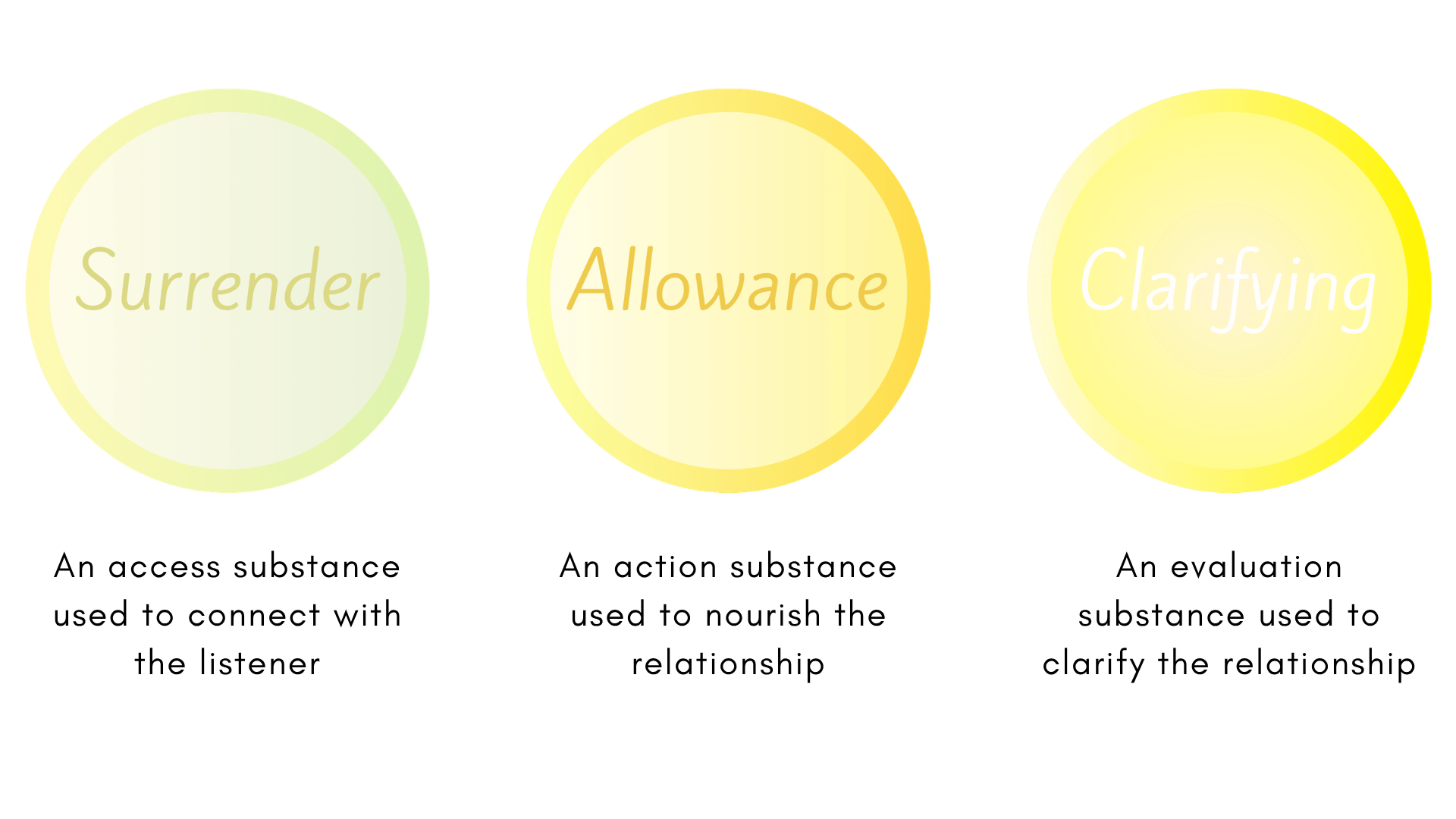
When the story shape lands in the mind, resulting in a range from inspiration to anxious and scattered, the storyteller can use the “Up” substances like surrender, allowance, and clarifying. Surrender puts a person in a more quiet passive state where you can be the listener and scribe rather than one coming up with all the good ideas. This strategy can help write dissertations as well as calm nerves before speaking up. When the storyteller interacts and collaborates with a person flying in “up”, we can surrender and let them cook. We give in to their process and trust that all is going as it is meant to. This substance is contagious. People can feel when surrender is present, and it can be inviting. When storytellers use the substance of surrender, we can watch the substance spread and marvel when the entire community leans back and enjoys the moment.
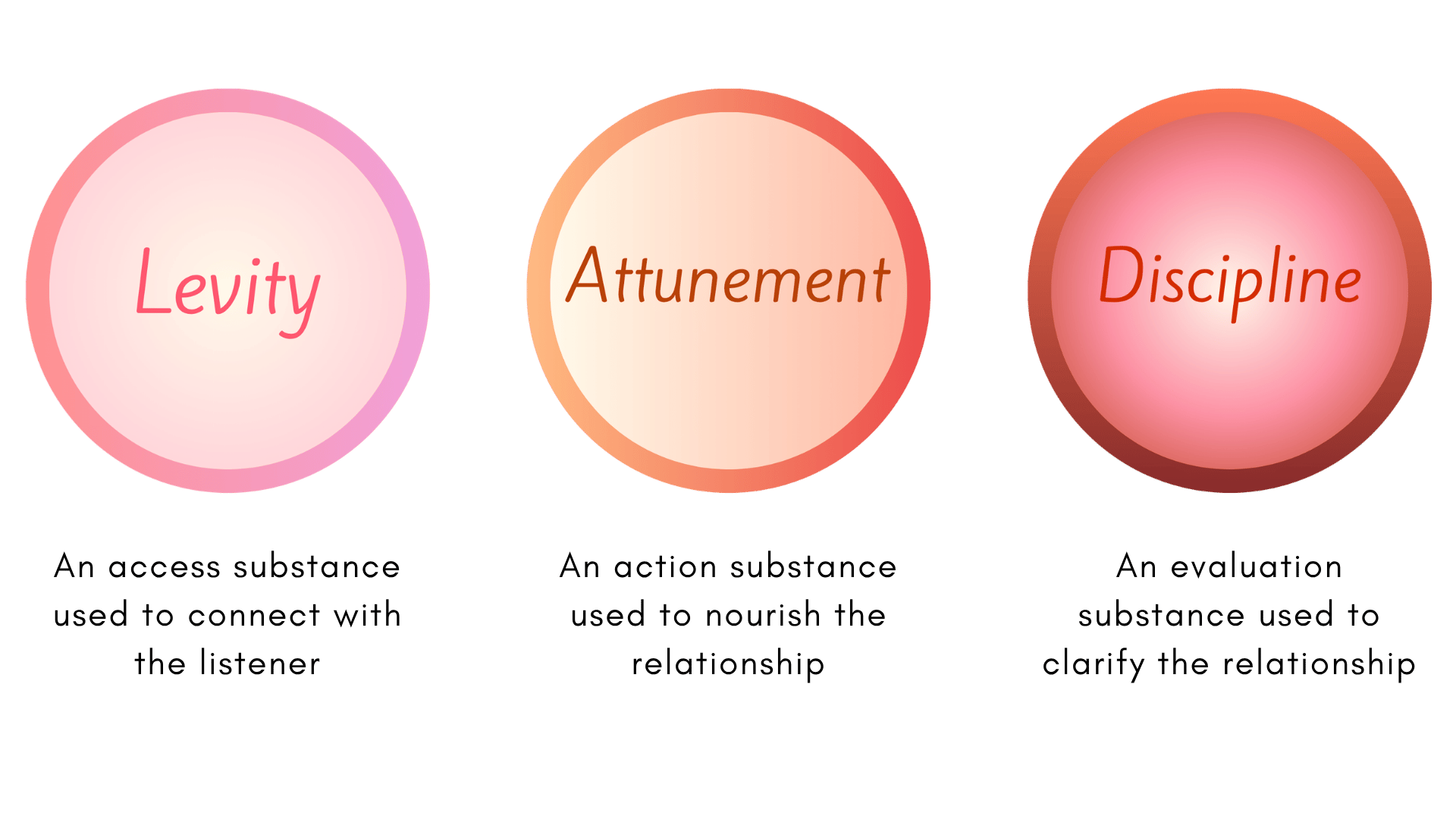
When the shape propels a person into action, and they lean forward in anger or resistance or attempting to challenge the status quo, then you can consider a “forward” substance like levity, attunement, and discipline. Many who find a home in forward are attracted to discipline as a substance, but as you will learn in mini-book #4, it isn’t what you think. It isn’t the discipline to work harder and find more effective tools, but to have the discipline to take responsibility for one’s self and actions. To turn the anger into something constructive by way of owning our actions. This substance helps us be better servants. We collaborate as members of a flock, rather than the ones in charge.
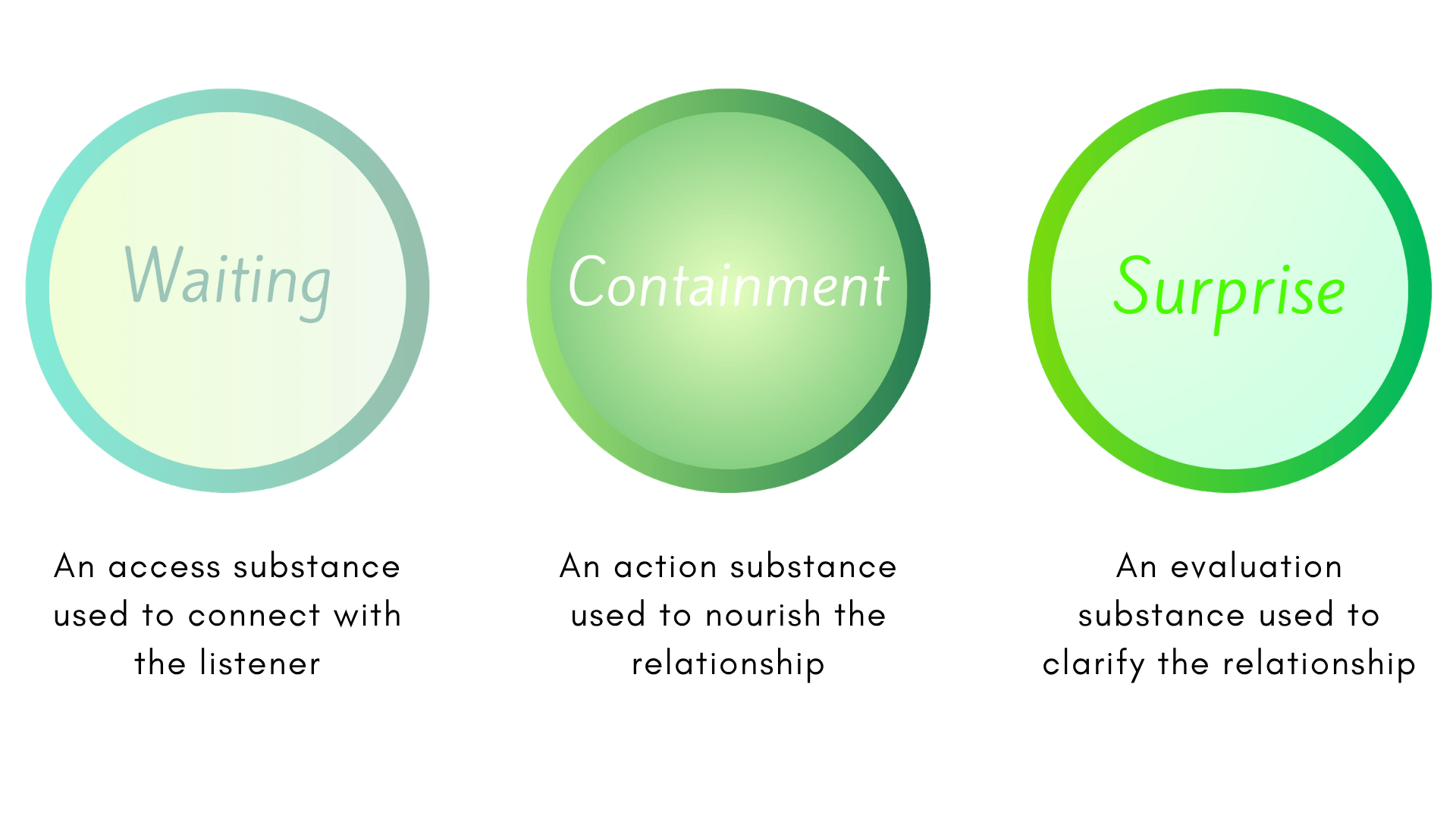
And when the shape slows a person down and they detach from what is happening, this can be scary for some people. They get concerned that they are numb and unfeeling. They feel lost and adrift, and imagine that this will be the case forever. This is when we can sprinkle some of the “back” substances like waiting, containment, and surprise. Here stillness is the salve. As the biblical quote says, “Be still and know that I am God,” meaning in this case that All-that-is can be experienced in any moment, and each moment is eternal. A storyteller sits in “back” and proceeds to wait. Waiting is a station, a place you can enter and spend as much time as you choose. It is its own thing. Interacting with others and collaborating with those in “back” includes waiting and holding in a space that is outside of time and place. It is the place of emergent images and information, and when we are patient, something powerful and surprising always comes.
In summary, the next six mini-books will look like this:
Book #2 will focus on the “down” substances of gratitude, savoring and longing (which includes the powerful energy of heartbreak)
Book #3 will focus on the “up” substances of surrender, allowance, and clarifying
Book #4 will focus on the “forward” substance of levity, attunement, and discipline (as it relates to taking responsibility)
Book #5 will focus on the “back” substances of waiting, containment, and surprise
Then Book #6 will show how to use these substances when working with others in your community.
And Book #7 will show how to use these substances when working with non-physical and multi-dimensional beings. Super fun!
Join a community of Storytellers and receive lots of free tools and courses. I'd love to meet you!
