Story Listening happens before Storytelling
Apr 12, 2026
Story Listening is a communication tool that will help you solve problems, notice more, empathize, connect more deeply and have more influence with what you say.
Restorative Storytelling casts a wide net when deciding what constitutes storytelling. Whenever we talk about something, it is telling a story. This means most of what we say, whenever we are talking about something casually or with intention, we are telling a story. We’ve been telling stories for thousands of years and it is the most effective way to get someone to listen, to connect, and to have influence.
The odd part is that most storytelling courses, training, philosophy miss the first step in storytelling, which is listening. In order to tell an effective story, we must first pay attention to the listener. We need to listen to our audience.
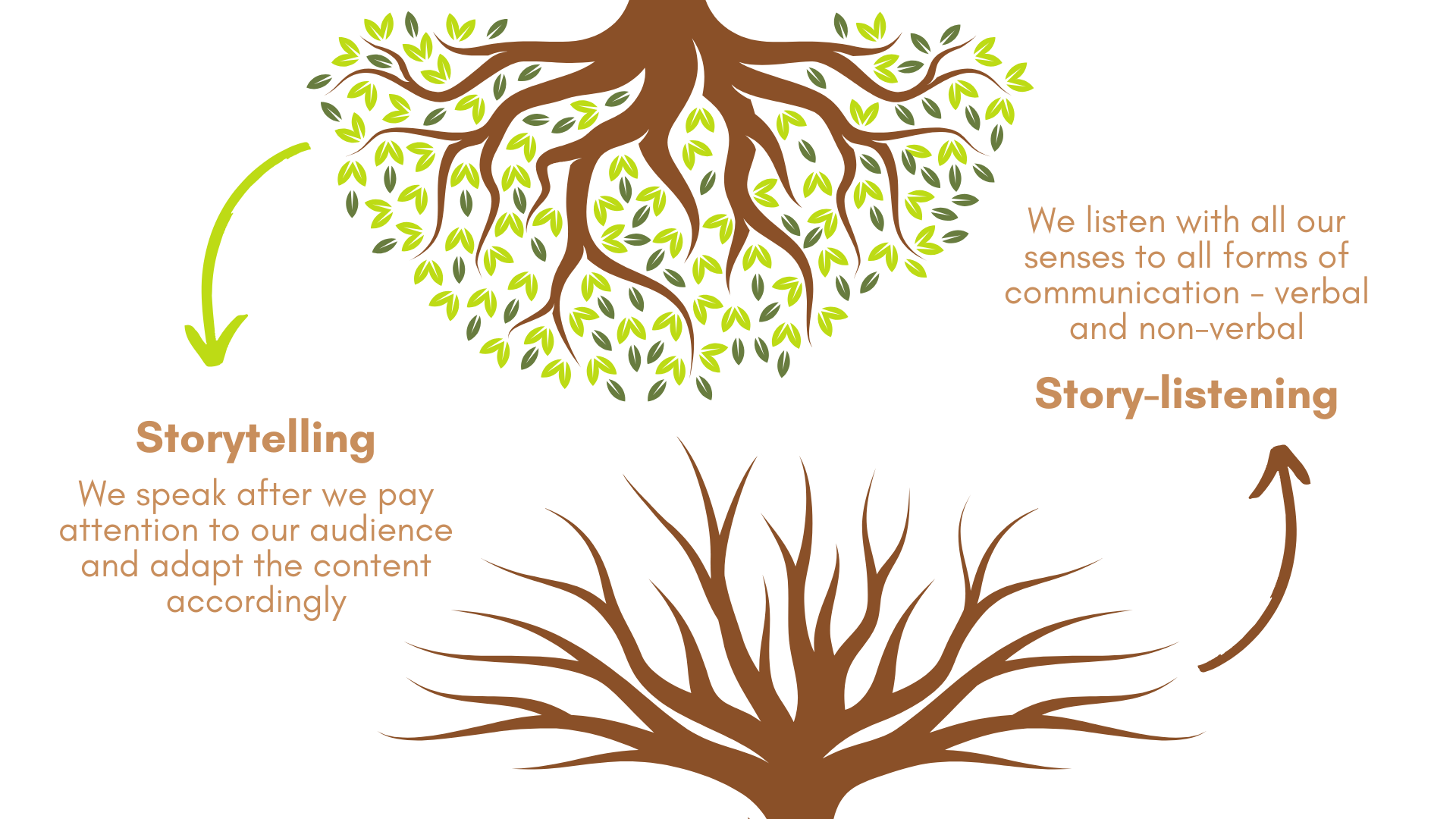
This can certainly include the people who like to listen to stories, but this is also your family, your partner, your kids, your students, your friends. Since we tell people stories all the time, it is essential that we learn to listen better, and in general, we are only taught one way to listen.
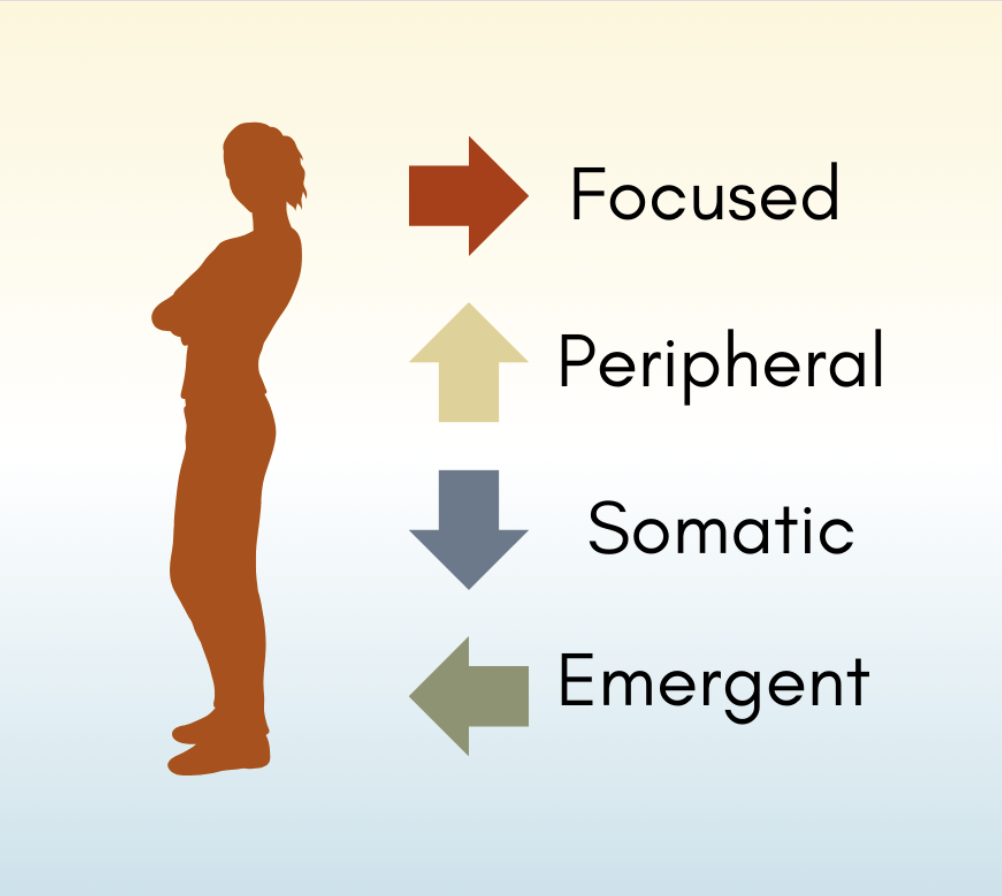
There are actually four ways to listen to someone.
Narrow listening is the kind taught in school where the priority is to recall content and be able to answer questions. This is targeted listening that is good at information retrieval. This kind of listening is not as efficient when seeking new ideas but it is solid for setting intentions and keeping in a lane or narrow field. Most of us probably call Narrow Listening just listening because it is what our parents asked us to do and what we were told to do in school. We are asked to listen to what someone says, and only that. This is why it is called narrow. The goal is to not be distracted by nonverbal communication or vocality - gestures, facial expressions, pitch and tone, or to the context or its connection to other stories. The point is to listen to the words, the content of what was said - which, by the way, according to popular studies out of UCLA, comprise only 7% of all communication. That is pretty narrow. Useful, but narrow.
One challenge with Narrow Listening is that it’s transactional nature can get in the way of good storytelling. Effective storytelling is more mythically and emotionally true that it is accurate or factual. Storytelling is nuanced and complex and delves into the subconscious, and Narrow Listening is about the conscious mind and the retention of information.
Therefore an effective way to use Narrow Listening in the RS model is with story containment. We use “containment” to identify the rules of your story or interaction. Getting clear on why you are saying, what you are saying and you you are speaking to is a powerful use of Narrow Listening. This will contain the moment so that you can use the other kinds of listening freely. It gives the experience form, and that form creates freedom.
Wide Listening notices peripheral information
Wide listening can resemble our state of perception when we first wake up from a soft nap,and we are filled with wonder at all the details of the world. Our attention simply floats around our environment and we maintain, for a while, a level of pleasant curiosity and wonder. We can access marvel and awe and we are not held down by our mind, by our thinking. Wide listening can also resemble what is commonly called “distracted” in that we are noticing the details in our periphery.
It is a multi sensual experience, meaning that all our senses are engaged, not just visually. In fact, in wide listening our hearing and sense of smell gets really strong and we can navigate the world more like our animal friends. We are immersed in the world and feel deeply connected to everything. Some of us, especially some of us who are described as attention compromised, can maintain this for a long time. Others return to narrow listening very quickly.
Wide listening gives us access to more information than when we are thinking through something or being strategic with our attention.
This gives us access to what neuroscientists are calling the new unconscious, which gives us information about why we do what we do. Clues from the unconscious show us why we vote the way we vote, why we like what we like, why we love the way we love and give us a chance to explore our identity matrix.
Here is an exercise that boosts wide listening
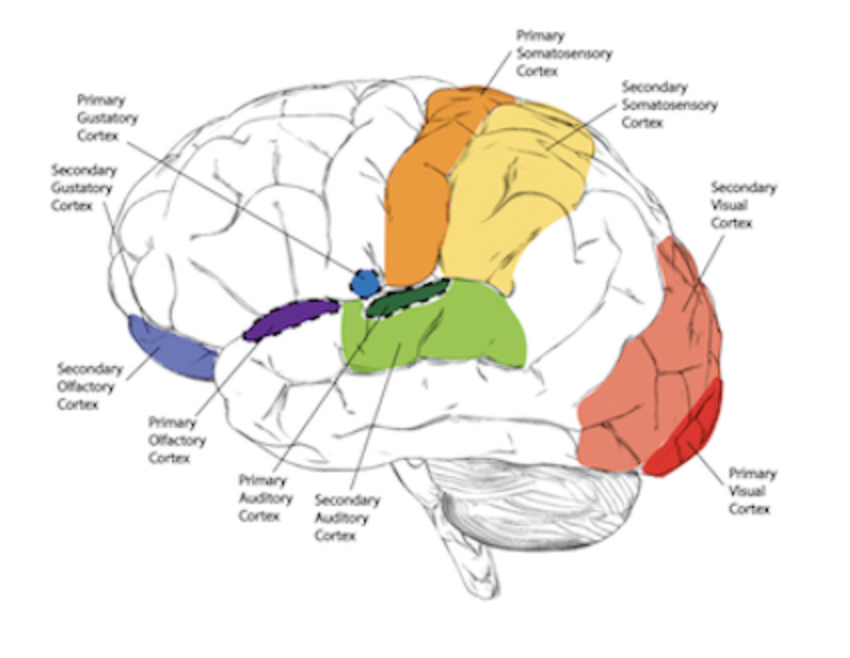
Studies of the brain and nervous system tell us that an overwhelming amount of wiring is built to support our vision.
For most of us, the default is what we see. But that precludes us from some valuable and sometimes essential information gathered from the other senses. To be a conscious and powerful storytelling, we must be conscious of this information as we are gathering it.
You can exercise that capacity by closing your eyes and listening. Listen to all the sounds you can, and gather them like you are collecting them in a basket. Notice which are far away and which are close.
Now sniff the air, and things around you: objects, your clothes. Smell everything.
Next, feel your environment and the things around you. Compare this object with that object. Notice texture, hardness, tap a few things to see what they sound like.
By now you will be filled with wonder and marvel and when you open your eyes, you’ll notice colors and shapes and textures far better without getting lost in the names and stories. You will see what you would have missed had you stayed in narrow listening. You’ll notice something new, and often toward clues to transformation.
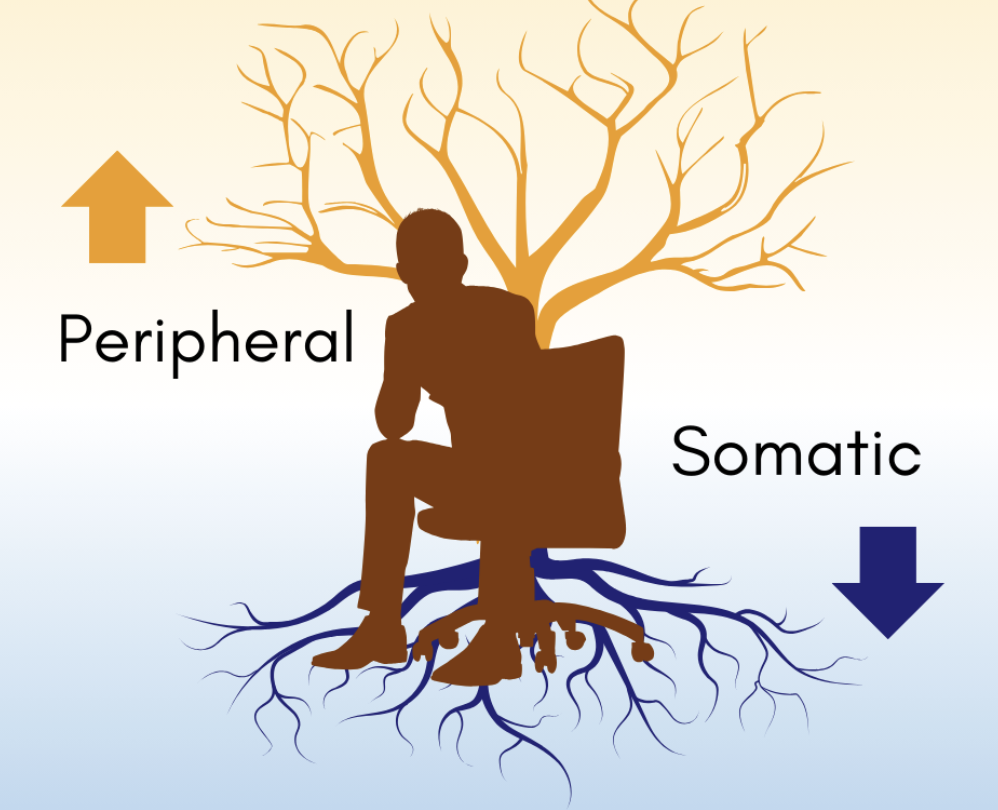
Dense listening is the most concrete of the four because it is all about your body.
It is about noticing how your body feels while you are listening, while you are paying attention. When you are keyed in on your somatic response to your environment, your body feels heavy and solid and dense.
The body knows more than the conscious mind. We have experiences in our life and those experiences have energy to them - emotion, sensation - we have the lived experience and then those sensations get stored in our body, in our limbs, our organs, our skin - and sometimes we wake those sensations back up and re-experience them without knowing what is going on. We get sad or scared or angry or feel flushed or excited and we don’t consciously know why.
Dense listening within storytelling gives you access to that information as well as a sense of understanding about what it is and where it's coming from.
Here is an exercise that will make dense listening easier to understand.
Focus on how sound waves affect your skin.
Emergent information about sound is that instead of waves, sound is expressed in spheres. If you imagine a pebble dropping in a pond, we see ripples going out from the point of impact. Now imagine the ripples going in all directions and you’ll see a sphere. Spheres of sound have impact, they have force that is strong enough to move small biological components in the ear and that movement is translated in the brain as sound.
Meanwhile the same thing happens with our skin.
Our skin can hear in the same way - we feel the sound because it has force. Sound can actually massage our bodies. We know this when we pause at a red light with someone really booming their subwoofers in the car next to us. We can feel the beat on our face. On our skin.
So the exercise is to feel sound. To try to hear things with your skin. That’s it. Just try it. If you have to use your imagination, then great. But give it a go. Every day. The likely result is that you will become more sensitive to the somatic response of your body to your environment. That sensitivity will give you information, and often important information about what is happening. When you listen with your skin, you have concrete experience of the effect of your environment, and this becomes empathy for the same somatic experience of your listener.
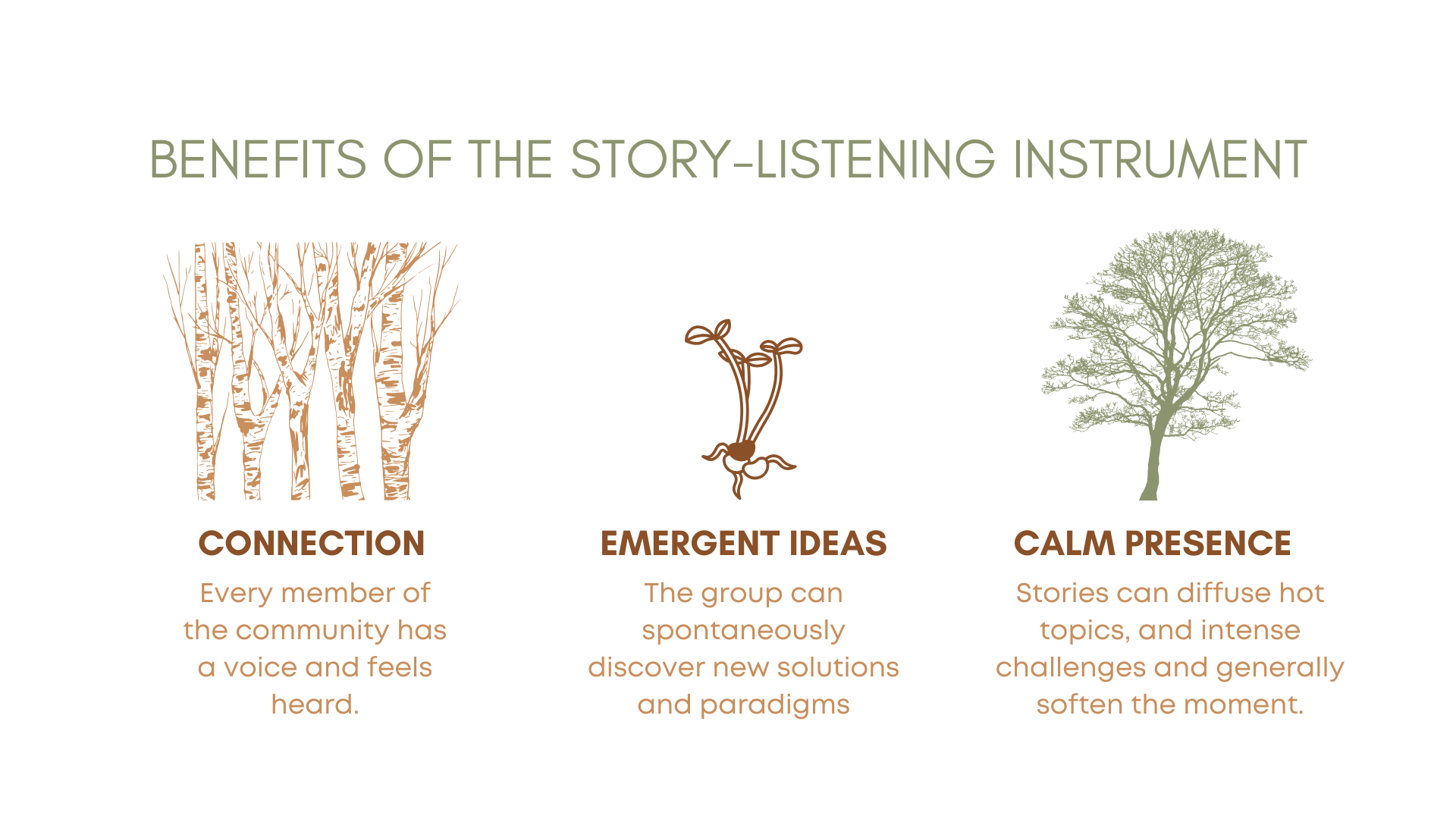
Emergent listening includes narrow, wide and dense listening, and it makes room for surprises.
The tricky part of Emergent Listening is you need to notice when something emerges before you dismiss it as silly or irrelevant or sometimes even rude. The best idea for a given situation may bubble up and since it isn’t necessarily a polite or obvious thing to say.
Emergent notions are gold - they change everything if you are willing to name them out loud. If it stays in your head, you are missing the opportunity for this idea to potentially change everything.
Emergent Listening relies on the information gathered from the other forms of listening. We pick up peripheral information from wide listening, somatic information from dense listening, content information from narrow listening and then we look for a signal.
Our subconscious brain knows exponentially more than our conscious brain and it signals advice through subtle signals. The most common way it does this is with goosebumps or the hair stands up on your arms. That is a way of signaling to you and your conscious mind that something important is happening or there is something to pay attention to.
You can create a vocabulary of sensations that mean degrees or kinds of emergent importance. You can feel a flush on your skin or get a chill or your face can get hot - there are all sorts of sensations that can become signals that something is emerging that needs to be named. It needs to be acknowledged and brought out into the open as something new. Your full self is telling you to tell a new story - or at least a new impulse to a new story.
The biggest impediment to emergent listening is worrying about upsetting others, but if you properly contain the naming, then people tend to be interested.
Here is an example. You are in a conversation and you engage in wide listening for a moment, notice something and your attention goes to a sound of a bird singing. You check in with your body and then an idea emerges having to do with the sound of the person’s voice. You then name it by saying something like this:
“I’m sorry but I was distracted for a moment by the sound of this birdcall, can you hear it? Well it made me think of your singing and I’m wondering if you are still singing”
This might diverge from the conversation but if you trust that this kind of listening is reading something deeper and more subconscious happening within the conversation, then your naming an emergent idea will be welcome. It will thrill them in fact because it is getting to a kind of deeper truth.
This is ultimately why we use all four forms of listening—to make deeper connections and exchange a deeper truth. Whether you use them in spontaneous storytelling, reading the room for a sales pitch or having a difficult conversation with your partner, it will take you directly to what is REALLY happening rather than remaining on the surface where everyone is behaving and being polite.
There must be a willingness to be a listening rebel and not let “politeness” keep you from accessing important information and making deeper, more enduring relationships.
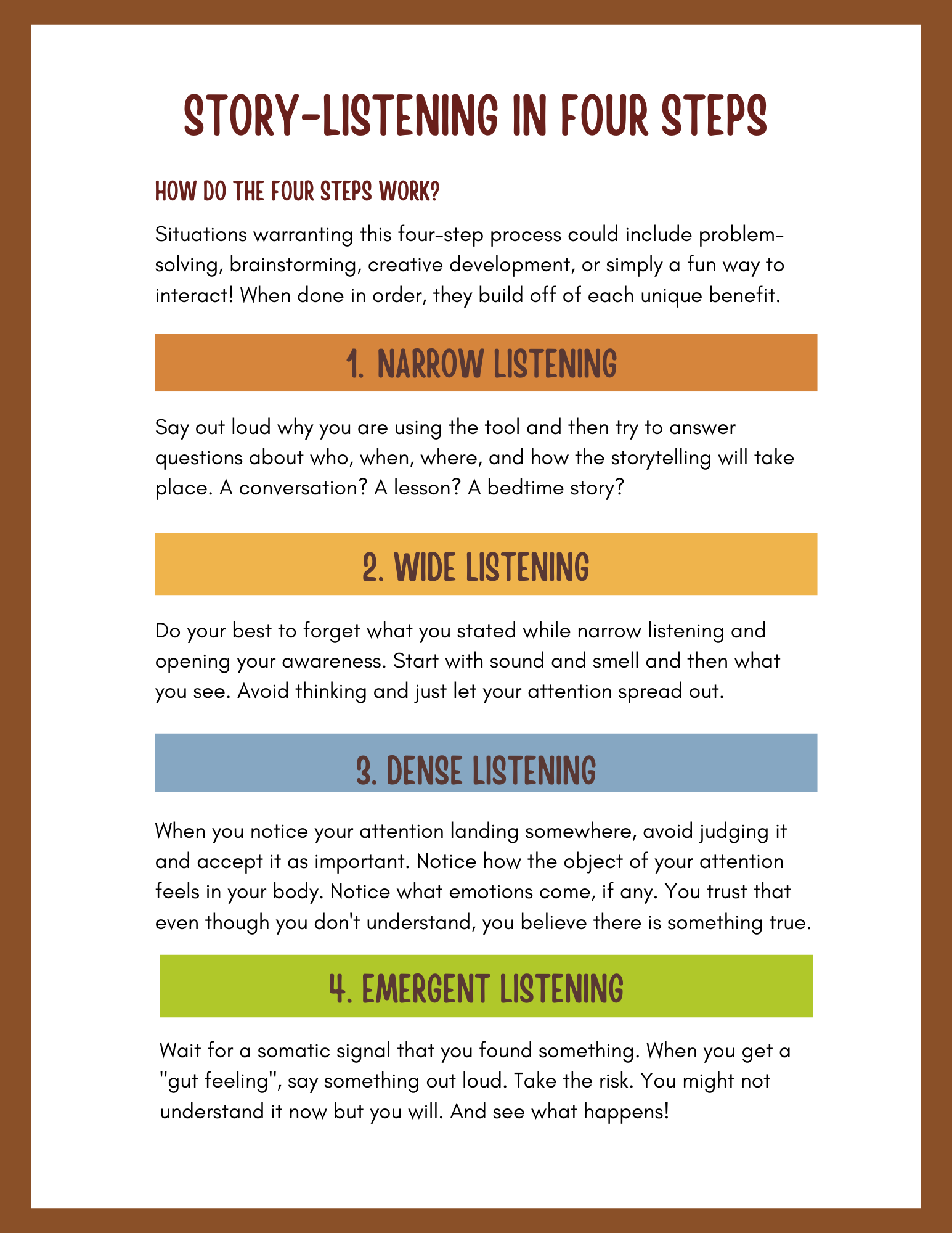
The Story Listening tool works best in a particular order but you can organize the tool however you wish.
If you choose to try this order, then follow this:
- Use narrow listening to set the intention and narrow the field of the story process. Give what follows a sphere in which to work.
- Within that sphere, widen the attention to include anything you can see, hear, smell or sense. Let all of it wash over you until something “catches” your attention.
- With dense listening, take that which caught your attention and sit with it. Take it into your cave for a moment and notice its effect on your body. You might learn something about it - something new.
- Then with emergent listening you honor that it doesn’t make sense right now but it might later. You give it voice. You let the object of your attention speak through you by naming it.
Join a community of Storytellers and receive lots of free tools and courses. I'd love to meet you!
