The Proper use of Discipline
Oct 18, 2026
“A disciplined mind leads to happiness, and an undisciplined mind leads to suffering.”
– Dalai Lama
“Nothing will work unless you do.” —Unknown
I have a team of multidimensional advisors who whisper cool stuff in my ear whenever I ask.
This, I believe, is something that is available to all of us. I also believe that most of us employ such a team, but call it something else: intuition, gut feelings, sixth sense, the whispered voice of a lost loved one. We all have thoughts and ideas and impulses and leanings that can feel as if they are coming from outside our conscious mind. There are times when a notion suddenly appears to us and it is the perfect solution to a problem that has been pulling our sleeve for a bit. Many see this as our subconscious mulling something and then, when the time is right, the thought moves from our subconscious to our conscious. Others believe this is the voice of God. Others think it is the work of fairies. It seems to me that most people don’t really think about it at all. For me, I have a conscious practice that identifies and personifies specific entities that are doing the whispering. This is something I delve into with the Intuitive Storytelling series, especially in step six where we consciously connect with something bigger than ourselves.

In my process, I identify a particular quality of intelligence and then summon it as a particular entity. I then interact with this entity or group of entities like I would a person or group of people. These entities share their unique intelligence and perspective and I come away from the interaction learning something new. This is how I write stories, this is how I make decisions, and this is how I change the way I feel. It works for me.
I have a group of entities I regularly consult with. Before I ask questions, I quickly go through the seven steps of Intuitive Storytelling and “tune” each of my chakras as I connect and dialogue with seven different entities:
- There is John-Paul who is a very silly entity. He is the one I’ve been working with the longest. He’s a clown-like tailor who loves to climb around in a web of ropes and rappel down to me with sage advice soaked in silliness. He is my access to levity.
- There is Pratyavatin, the most recent addition to the team, who seems to be an expert on both physics and music. She works with crystal bowls and is often very busy focusing on something else. She is wicked smart. She is my force of attunement.
- Then there is MJ, who I used to call M before I realized she was a version of my grandmother, a version who never got married and had kids. This version was more like a strident Amelia Earhart, and I see her as my toe-hold of discipline
- Lastly there is the Aldebaran, who are actually four separate entities that speak from four different points of view. One speaks to me personally, one speaks to me as a human being, one as a member of the universe, and one as a member of the multiverse. The Aldebaran are aliens
Still with me? Again, I really think we all consult with beings like my list above, but most of us don’t investigate their personalities, histories, and citizenships. We just think of them as an inner voice or hunch. I am a storyteller, so I’m interested in the personal details. There is a LOT more to say about each member of this team, but here is what they say about discipline:
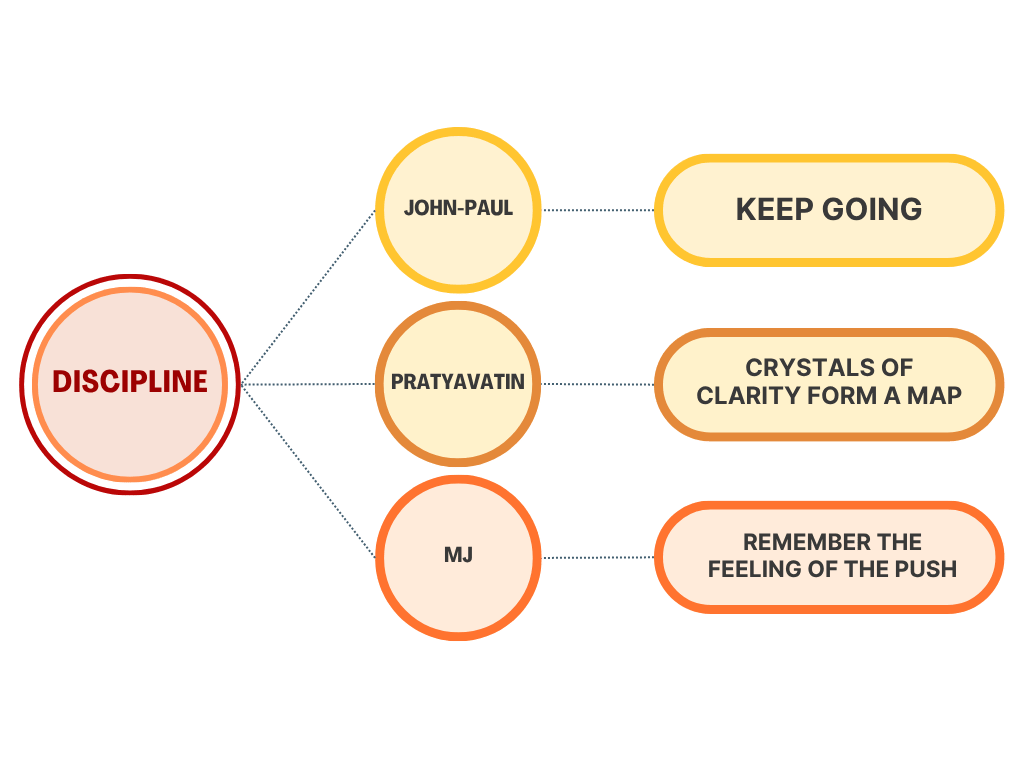
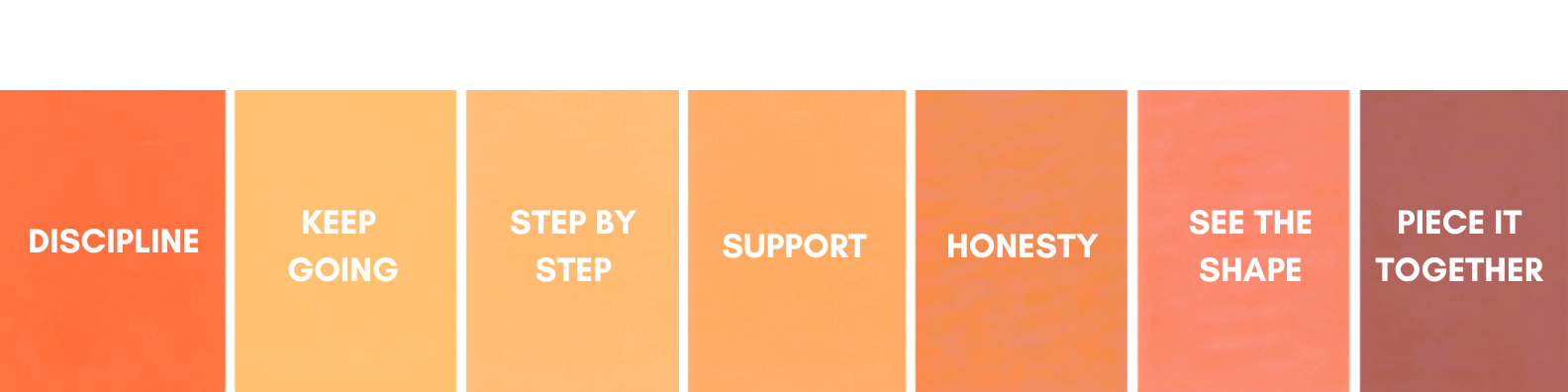
John-Paul: “Keep going. It really can be as simple as that. Something happens when you continue to move toward something, especially when things get gnarly. When you keep going, surprising things happen.”
Pratyavatin: “There is a crystallization that occurs with focus. When your attention and your will coalesce around a particular topic or intention, a series of connections begin to form and spread out in a pattern. From a dimensional standpoint, it is like watching water freeze and form ice crystals. It forms a series of shapes that become a map to follow. Like invisible ink revealing directions when the moon shines a certain way. The fruits of discipline are clear for only a moment, and in that moment you act. You step forward.”
MJ: “You can recall moments when you pushed through to finish something. These are of high value to you. Your bike trip, home renovations, your dissertation, these have all been difficult and you have pushed through to not only get them done, but to do them well. You equate them with integrity—doing what you say you are going to do. You mustn’t confuse discipline with the pushing, however. It is not the push. It is the feeling that comes when you do it. Focus on that.”
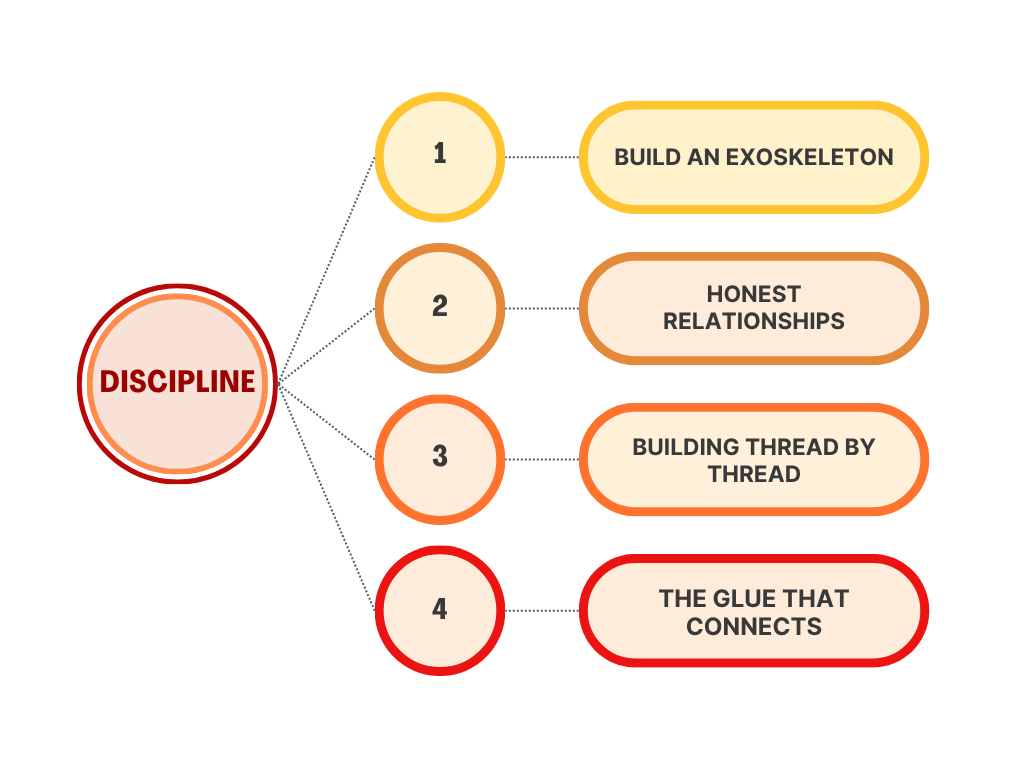
Aldebaran One: “Using discipline is like having an exoskeleton. Not for armor but for added support. You feel your limbs contained and stronger as you move through life, and it gives a certain confidence and agency as you make choices and follow through.”
Aldebaran Two: “Discipline in a relationship is about honesty, and this can be a relationship with yourself. No rationalization, no avoidance. It is also not about burdening through oversharing, but things need to be as they are with no excuses. When you speak, you have the discipline to tell the truth. To be authentic, clear, and take responsibility for whatever you say and do.”
Aldebaran Three: “Structures are made of discipline, like a web is made of spider’s silk. You choose to create something, it gets organized thread by thread, and then there is a moment when you can step back and marvel at its completion. It is something made in both form and time. The moment something is complete is when you can clearly see that discipline was used. And then you no longer need that structure—you are free.”
Aldebaran Four: “Discipline is the glue connecting what is real. Images float and tangle, but discipline is the weaver of golden threads into castles”
There you have it!
The shape of discipline includes an intention or invocation.
The first threads form this intention and then decide on the next step. And then the next. The developing shape works like a beacon, unique in all the world, that attracts what happens next. This continues intuitively and almost instinctively until something is built, seen, and assessed. And then we can see the discipline that formed it. Discipline becomes clear when we properly and intentionally put something to bed. We close well. We end the thing knowing full well that it is complete and will be the foundation of the next thing. And the feeling that results is a kind of freedom. That combination of discipline and freedom is the connective goo that creates what we know as reality.
I love the NBA and my team is the Celtics.
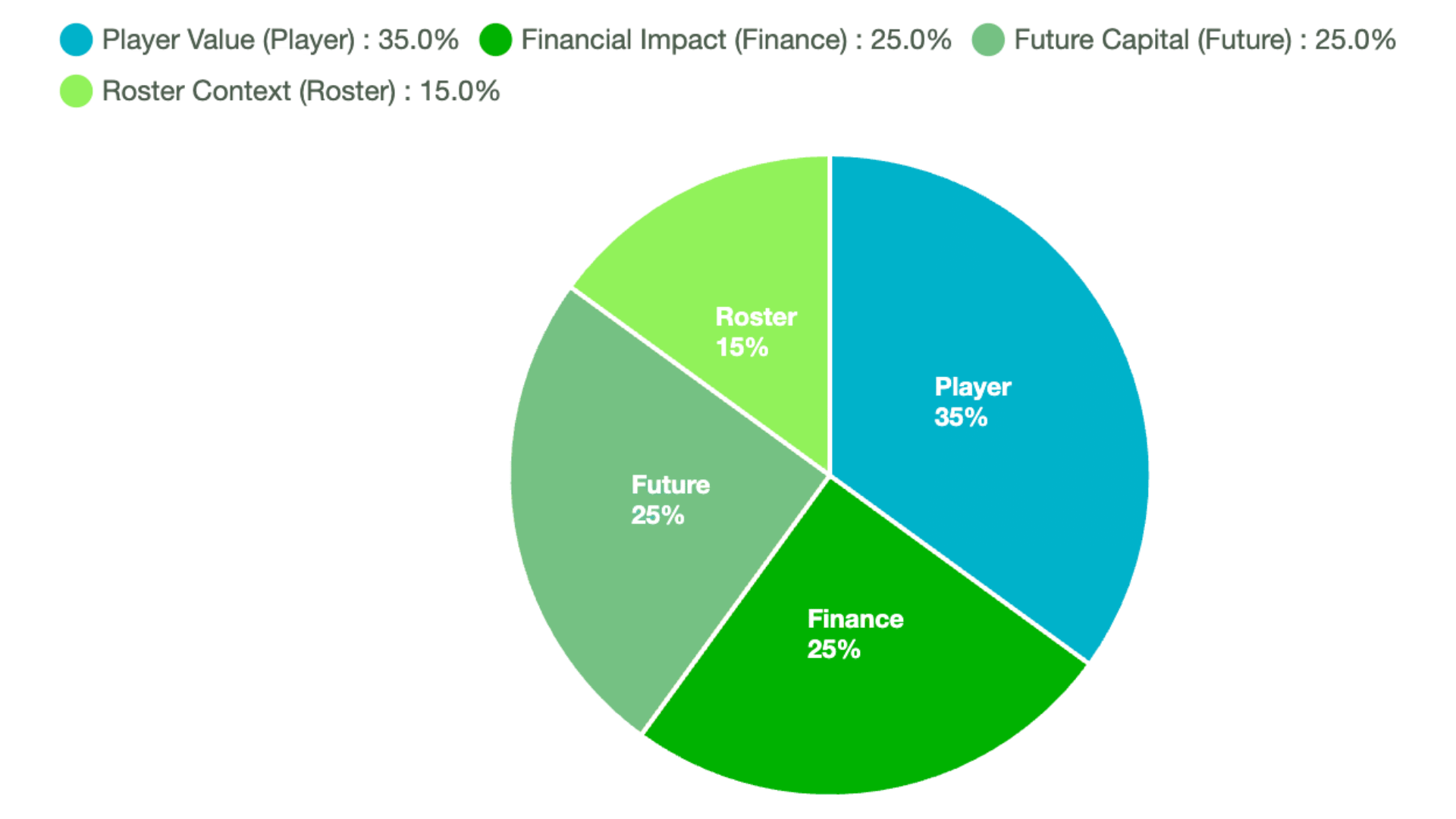
My team changes each year. The general manager looks at the roster at the end of the season and reconciles what just happened during the season and post season, considers the plans for the team and then how much is accounted for in each contract, considers the draft and who are the prospective players available, considers the players who are free agents, and then the great shuffle begins. There are a great many variables at play, but the GM and their staff reconcile the entirety of the team player by player, contract by contract, adding it all up and iterating the plan to meet the moment. Sometimes the reconciliation includes the need for certain players to develop their game—they need to fix a shot or learn something new. Or they need to focus on their defense or deeply heal from a lingering injury. Each player contains multitudes and each team is composed of multitudes of multitudes. This goes on and on and is infinitely complex. So how do you proceed, knowing the deep complexity of the process? My team tells me that you are present in the moment, you feel the untethering gift of levity, the relational gift of attunement and then you find the developing shape.
This is the role of discipline. When you find the developing shape, you begin to finish it, and then you set it free.
This is all conceptual and might have a feel to it, but what does it look like in our lives?
Let’s look at this substance from the perspective of a relationship. Many of us want to be matched well. We want a partner that meets us where we are and inspires us to be our best selves. We want to have fun with our partner, while building a life and solving problems together. We might want to have kids and are looking for a partner that agrees with this plan. We might have a public facing aspect in the relationship that evaluates how the partnership looks in public. People are complex, and relationships, consequently, are that much more complex. So how do we find the right person? We have relationships, we learn from them, and then we make changes in our process to attract a better match in the future.
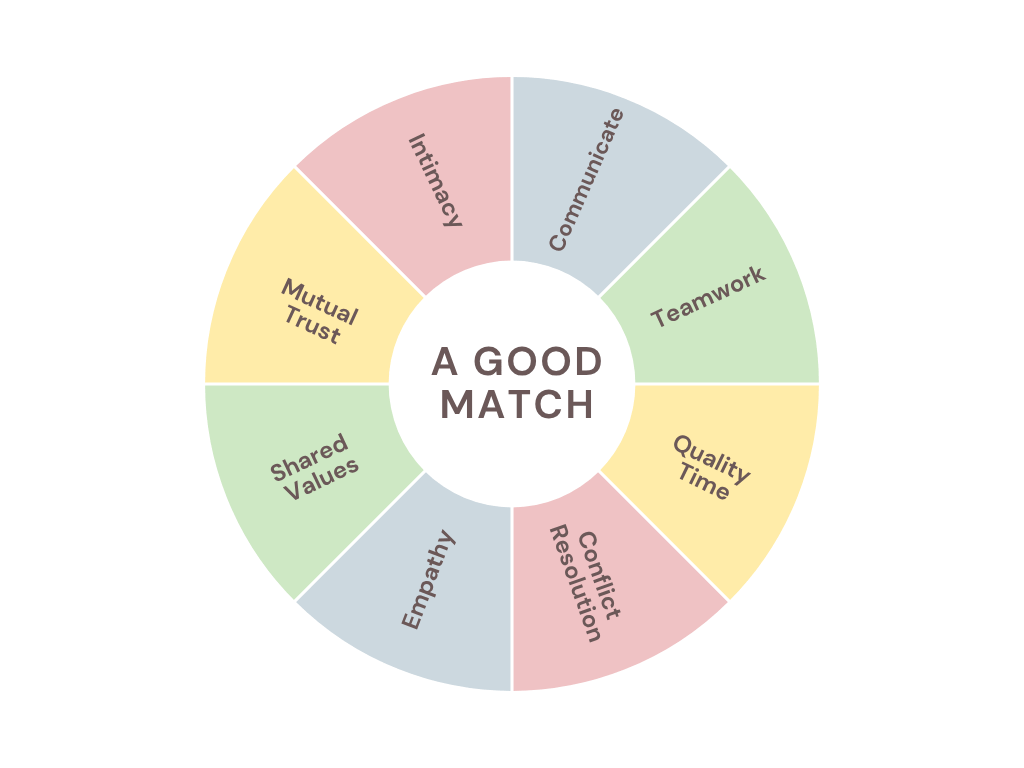
I am elegantly matched in my marriage. This is my second marriage and my first marriage took place after I was a part of many partnerships, or primary relationships. I had a number of girlfriends and each girlfriend taught me something about who I was, what I valued, where I wanted to go, and what qualities I was seeking in a partner. And if I understand what my team is telling me about discipline, I built a shape of threads pulling from each relationship, which then became the foundation of the next relationship. I kept going and building and learning. The lessons, the qualities, the events of the relationship informed how I’d go about finding and manifesting the next relationship. And here I am with the relationship “of my dreams”. I now enjoy balanced cooperation with someone who inspires me, attracts me, delights me, and makes me want to be my best self. I feel free. I feel liberated from the relationship cycle because I have no notes. I have nothing I want to change. I have arrived, and now I can look back and see the discipline that got me here.
I won’t pretend to understand how karma and reincarnation works, but one description positions karma as an evaluation of a life lived, which then informs the next life.
If this process were a game (and I think it is), then one goal of the game could be to become more and more liberated with each life from the karmic cycle until you no longer play the game at all. You are free. You don’t cycle back into earthly life and enjoy Nirvana or eternal bliss. With each life, with each relationship, with each project, with each decision, we create a shape, then a plan, and then we weave a castle only to let it go and look to the next. We nail it, we have no notes, and we are free.
If you are like me, you are marveling at the idea of nailing it. The idea that you have no notes for a project or relationship or life seems absurd. Of course we can improve, right?! Well, I feel confident that you have already experienced this level of freedom. There are projects, relationships, events, that you no longer need to improve. Have you put together the perfect party? Have you owned the perfect pet? Have you manifested the perfect grilled cheese sandwich? Have you heard the perfect joke? The microcosm is the macrocosm. In this game, a little detail about owning the perfect pair of shoes makes all the difference. It is not insignificant when you finally put on the perfect pair of shoes. You look back and see the discipline that got you here. Then you feel complete and liberated.
But let me be clear: the result of a conscious reconciliation is rarely perfection.
Usually we create a shape for something we want to approach again and try a different way. Most of our relationships could use an adjustment. Most of our experiments at work could go better. Most of the birthdays, celebrations, vacations, and weekends show us ways in which we could do them better. This is the bulk of the game, and it is important for us to keep going. Our universe is made of that impulse.
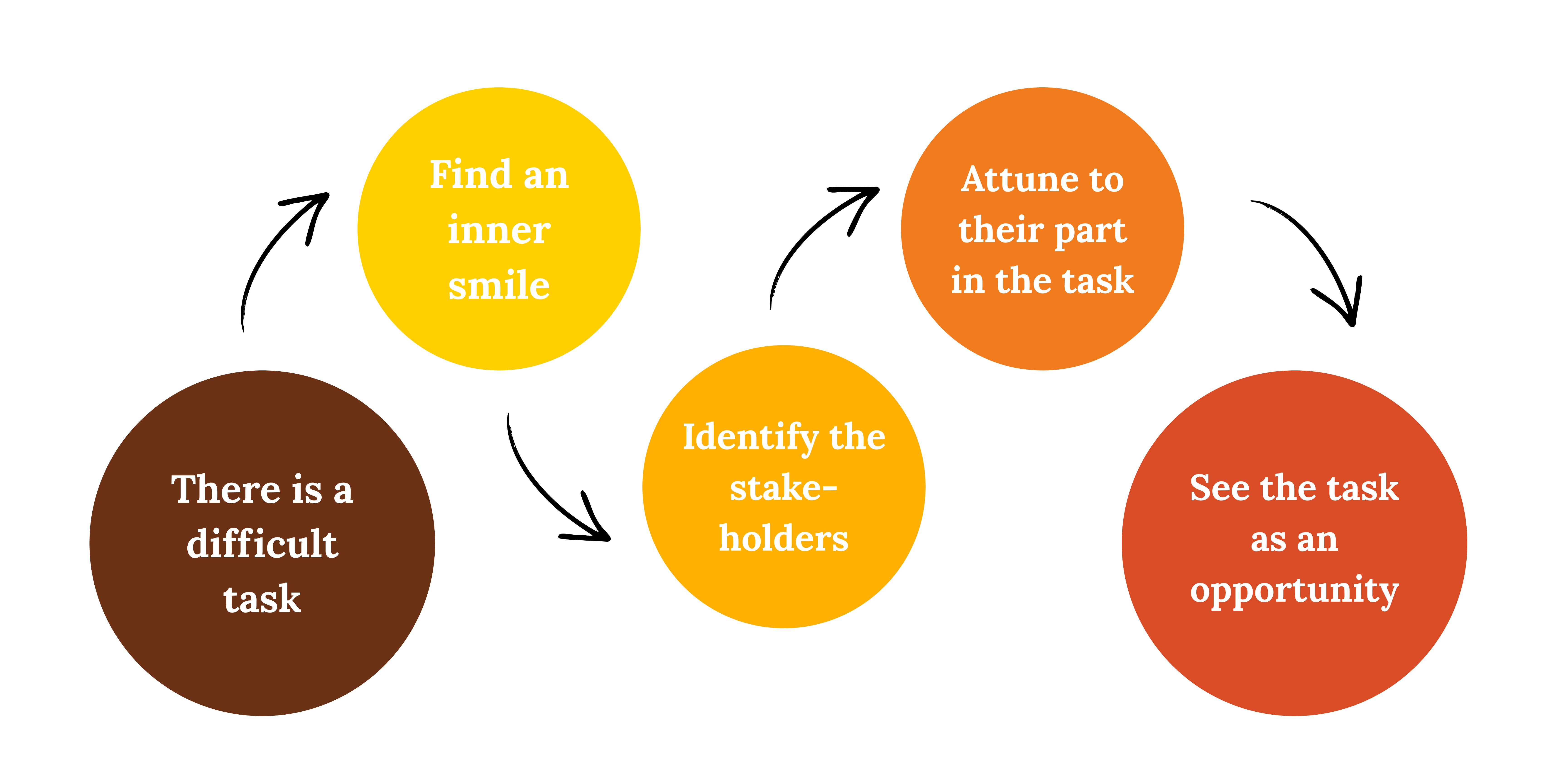
Exercise: Using all three action substances
- Set a course. Where do you want to go? What do you want to do? Is there something you want to learn? Ask your question.
- Get light. No matter the seriousness of the topic, invite levity. Make a face or a silly sound. Get yourself to smile.
- Share your course with another person. Move this question and intention into a relationship. Invite someone in.
- Vibe with this person. Be curious about them and try to reach their frequency. Watch with interest and care. Tinker, adapt, respond, and enjoy.
- Keep going. Build while making room for doubt, wonder, and confusion. This is a part of the process but appreciate where you are in every moment.
- Pause from time to time to look back and see the discipline that it took to get where you are. It is working.
- Finish it. Do what you must to complete your course and answer your question. Be honest with yourself and others. Then close.
- Feel the associated freedom. Enjoy it.
- Then look to the next course to set!
Join a community of Storytellers and receive lots of free tools and courses. I'd love to meet you!
