Visual Storytelling: Why Body Language Is More Powerful Than Words
Feb 09, 2026Transformative Storytelling Versus Information Transfer
My undergraduate degree is in printmaking, and during my freshman year, I took a drawing class taught by the Dean of our college. I recall early in the semester, he asked us to draw something “narrative” as opposed to “illustrated.” My memory is that he did not give us much instruction other than the distinction between these two ways of drawing: one tells a story, the other is an explanation.
I didn’t understand.
I vaguely recall drawing a picture of a fairy tale with fuzzy, “arty” lines rather than the crisp lines that I associated with children’s book illustrations. One of my fellow freshmen drew a picture of a man—a big man—who looked like he might be a king sitting on a throne. The man was leaning back with his hands clutching the armrests, and he was wincing. I couldn’t understand the specifics of the image, but I could feel it. I could feel the wince and the clutched hands and I knew that the man was experiencing something profound, possibly painful or ecstatic. It wasn’t a particularly accurate or detailed drawing, but I was moved by the image, and I can picture it to this day. He told me a story rather than merely depicting a portion of text.
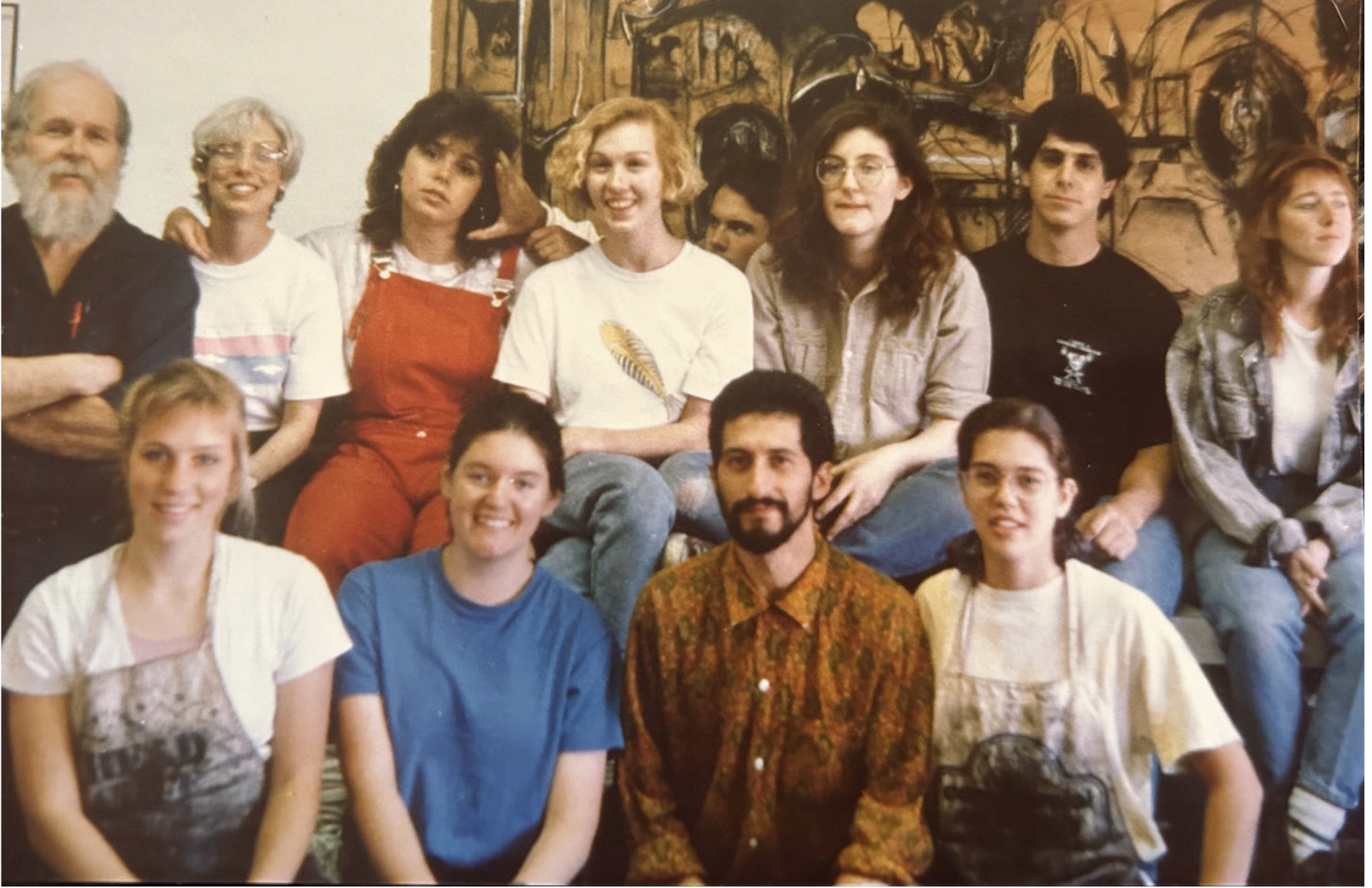
This is a photo of me with the printmaking department. That is my image behind us, and I am hiding in the middle.
It was a full storytelling experience, rather than an intellectual representation.
From that point forward, I wanted to be a storyteller because I realized narrative wasn’t about transferring information, it was about impacting and even transforming the listener (or in this case viewer.) My friend’s king image changed me, my drawing was simply trying to tell something.
The Power of Visual Storytelling: Narrative Density
This means that when we see something that inspires, upsets, or moves us, we have encountered something that is dense with story. The more it affects us, the more dense it is with stories, because density attracts. Gravity is a good example of how this works. Gravity is an attractive force that acts between any two objects with mass. It is what keeps the moon orbiting around the earth and what keeps us from floating off the planet. The earth is dense and gravity keeps us attracted to it.
This interests me as a storyteller: The greater the mass, the stronger its gravitational pull, the more attractive it is. So the more narrative within an image, the more attractive it is to the listener.
Understanding Narrative Density in Visual Communication.

Dense stories have more pull, and since our brains have far more visual processing going on than any other sense, “a picture is worth a thousand words” is an understatement. The picture, it turns out, is most of the story.
How Advertising Uses Visual Storytelling Techniques.
This is why Big Pharma commercials are so effective even though they have the narrator listing potential (and ridiculously bad) side effects. We joke about the list but meanwhile we watch images of happy people enjoying their community. The visual storytelling in the commercial is transforming us even while we laugh at the content. It transforms us even if we know better.
Effective politicians understand visual information and narrative density. They know that an election can suddenly swing on something narratively dense. Dukakis lost because of the way he wore a helmet. Dean lost because of a clenched fist and an enthusiastic scream. Clinton won because of the expression on his face when he “felt your pain.” Trump won because he projected confidence. These images burn into our consciousness because our brains are built that way. No one talks us into this, it just happens.
Visual Storytelling Skills You Can Learn.
When a storyteller reads a room, and responds to the moment, we begin with noticing our presence and body language. This is always the case. We intuitively know that our presence and body language is what is going to grab a listener’s attention. Opening our mouths and speaking is actually the last thing that happens. We know that how we look and what we are presenting is key. This is understanding visual storytelling and body language.
This is not a mental thing. It is not something calculated or in most cases even consciously considered. For most storytellers, we begin with a gut feeling or intuitive inclination and then we act on it. We check in with our body. We note our presence. We sit with how are we feeling in this particular moment. Then we play with our posture, gestures, facial expressions and other “signals” to the listener, and when we find something that seems to fit the moment, we proceed.
Why Visual Communication Trumps Verbal Content.
Most people think the power of storytelling is about the words, but the fact is, we are far more moved by what we see the storytelling doing than by the content of what they are saying. It is the first line of communication and it works like a gate-keeper. If we feel aligned or interested or moved by the storyteller’s body language, we are willing to listen. We trust and allow the story to work on us.
If we don’t trust, we don’t listen. We might remember some of the words, but we aren’t going to be moved or transformed.
How to Tell Stories Effectively Using Body Language
Recognize that in every second, you are taking in 11 million bits of information, but your conscious mind can only hold 30-40 bits. Much of that information is an interpretation of what you see. Let us accept that visual information is king. So how do we leverage that fact as storytellers?
Since most of our read of a room is visual, and most of it is not conscious, how do we know how to respond and win the listener’s trust and attention. By focusing on the body.
Developing Storytelling Presence Through Body Awareness.
Transformative storytellers have a vocabulary of sensations and states of being that they use to read their listener and respond. When you pay attention to your presence and physical sensations, you learn how your body is a very sensitive instrument that you can consciously use to inspire, motivate, and calm a room full of people.
Notice how your body responds to things you hear or see. Trust that whatever you notice is your body trying to tell you something. Your subconscious sifts through all the billions and billions of bits of information and finds the good stuff that is in alignment with your listener and intention. This, in my opinion, is what intuition is: we have access to a massive amount of information and can finally use it.
You can then start to map the sensations in your body. Explore the subtle difference between wariness and fear, of irritation and resentment, of hunger and desire. Notice the temperature in your hands, or any discomfort in your back. The practice is not about obsessively charting every shift in sensation or emotion. The point is to gain consciousness by being curious and exerting your will a little. It is about developing a habit of awareness.
It is much like learning to remember your dreams. We have these highly impacting experiences in our dreams with heightened feelings and dramatic images, and then we forget them upon waking. When we are curious about them and make a practice of remembering them, we are not only able to recall what happened, but some of us can actually influence our dreams.
The same is the case with storytelling. We can have an influence on our environment. We can inspire transformation in our listeners. The trick is to avoid being seduced by the content of the story and focus on what is measurably more relevant to human brains and how we behave: visual information.
Join a community of Storytellers and receive lots of free tools and courses. I'd love to meet you!
