This is how you end a story
Apr 06, 2026
I’m going to begin this post with a contradiction: endings are not important. That said, they might be, but it depends on the narrative density of the ending. I’ll explain.
The effectiveness of a story is never due to the whole story.
When you think about the stories that motivated you, soothed you, inspired you, and transformed you, it is very likely that it is an image or moment in the story that is responsible. As in life, a story in its entirely serves many functions and lives in your memory in pieces rather than as a whole.
The entirety of the move Hamnet doesn’t make you cry but there are few key scenes that do. The entirety of Man’s Search for Meaning doesn’t set you to social action, but a few key phrases do. Walt Whitman’s entire opus Leaves of Grass isn’t quoted, but “I contain multitudes” sure is.
My point is that the gold in each story is in its images and moments. The transformative power might happen at any point of the story, so the “all is well that ends well” notion that stresses out many authors is simply not that important when your goal is to deliver something in service to the listener.
That said, the gold might indeed arrive in the ending image. So with that in mind, let’s stick the landing.
The twelve storytelling strategies are divided into three groups: those that are particularly suited for starting stories, those that help you move through the bulk of the story, and those that are designed to close a story. I recommend you click on the above links to learn about the starters and maintainers. As I have mentioned many times, any of these strategies can be used at any point of the story. I am simply demonstrating how I tend to use them.
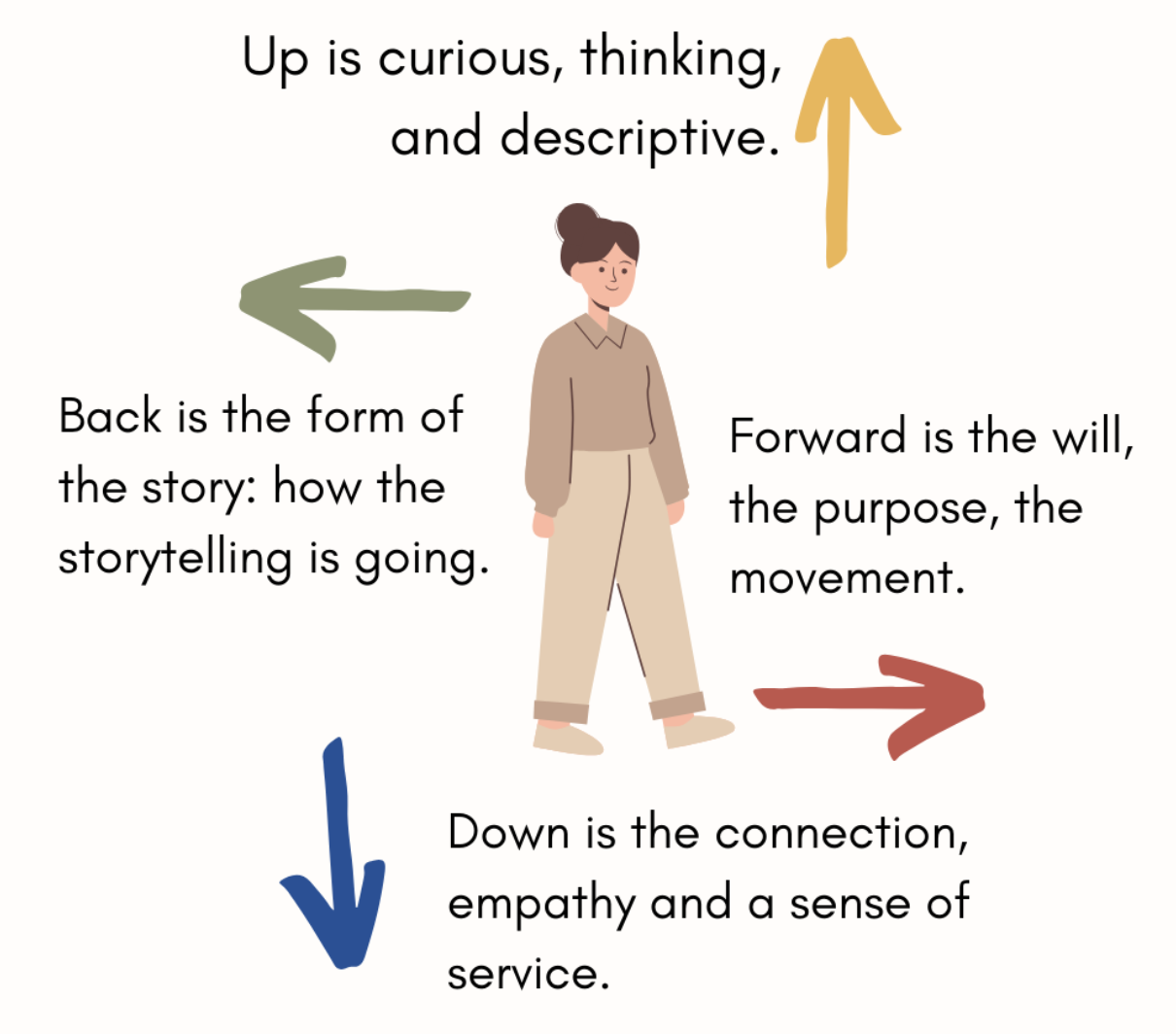
Of the four closing strategies, the Connector is considered the more mental and spontaneous approach, the Romantic is the most somatic and feeling-based, the Guide is for those that like to work and plan out their stories, and the Revealer is the one for those with trust and faith in the story. It is the most magical. Here are the approaches and an exercise you can try. For more exercises, I recommend getting the full workbook here.
These closing strategies all wish to end the story effectively.
While the Connector will yield a nodding “ooooooh nice” from the audience, the Romantic will yield an emotional “Oooooo sweet.” The Guide will bring an affirmative “got it” from a respectful listener, and the Revealer will bring a wide-eyed, “Woah!” as everyone is surprised.
The Connector impresses with their ability to tie it all together elegantly with a bow.
And though the result is often a well built story, that is not the intention of the Connector. They are interested in mentally piecing things together in an intuitive fashion: quickly and instinctively.
Connectors move fast.
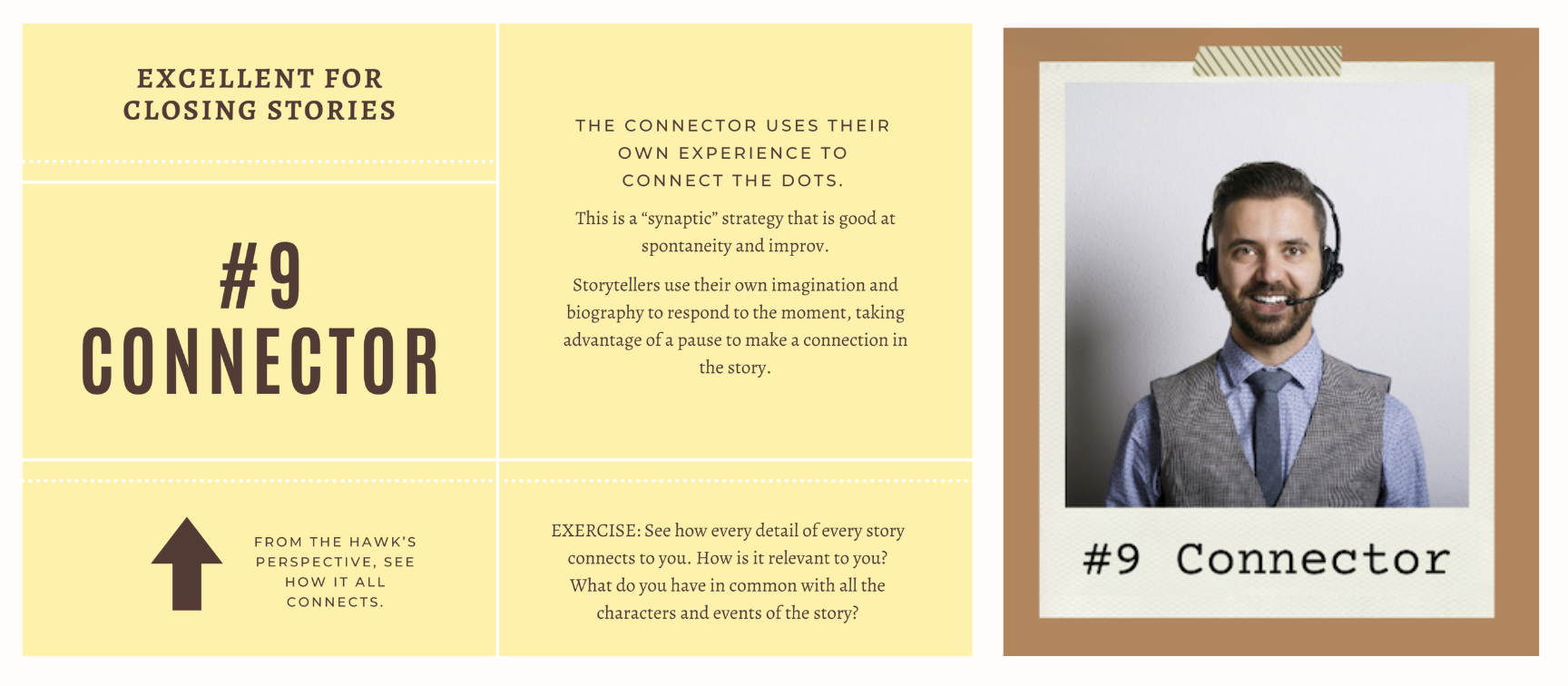
Though it is a “thinking” type, it does not mull. It does not ruminate. They default to trusting whatever occurs to them as the right move. It is a deeply intuitive and synaptic storytelling strategy and one that strengthens through practice.
Connectors are the most spontaneous of the twelve—they can make any situation profound and fascinating, just by linking one thing with another. People can compliment the Connector’s mind and they aren’t wrong—but it isn’t the complexity of their thinking, so much as their confident trust in their intuition and instinct. They wouldn’t be able to convince you their way is the right way, but once the story is over, you can’t deny it is genius.
Exercise #1: Break the Story
Set an intention for a story you’d like to tell. Is it to help your child? Is it to bring revelation around something curious? Is it to work through a conflict at work?
Distract yourself. Let your attention widen and wherever it lands, start your made up story there. Tell the story without caring. This is just you, no one is listening. Don’t try to be interesting or cute. Just talk.
Here is the important part: the moment you find yourself trying to control the narrative in order to fulfill the intention of the story, intentionally break it. Immediately change course and introduce a new character or notice something and comment on it. The point is to stay completely in the present without a plan.
Finish the story whenever you want and then review it. You might, upon reflection, notice there was something worthwhile after all!
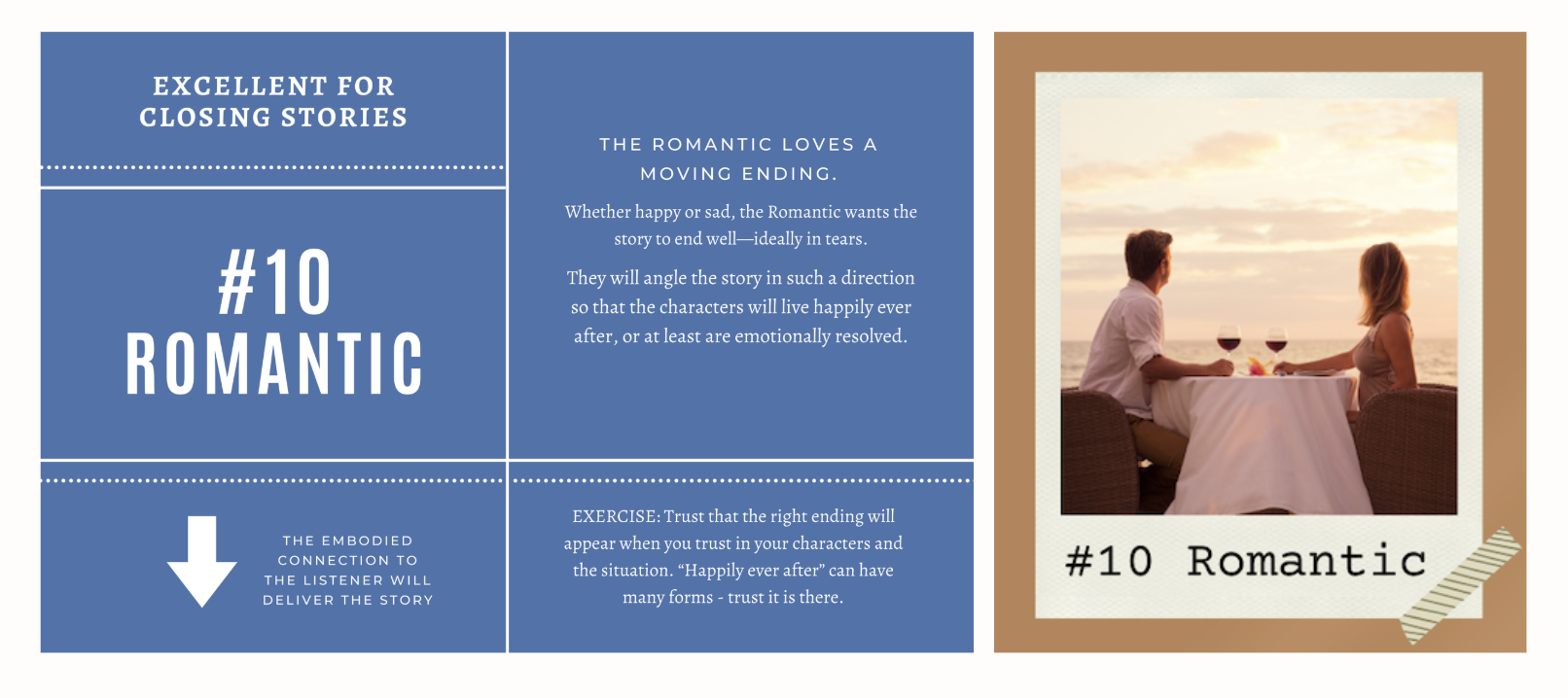
For the Romantic, everything is a love story and true love is the only story to tell.
In the end, the true love outlasts everything else - even the lovers themselves. It is a particular lens through which we see life and organize our storytelling. It is not thought out. It is not calculated. It doesn’t make sense. It just feels right.
If the audience sighs at the end, then the Romantic feels they have done their job.
That said, there are many ways to sigh, and they are all satisfying to the Romantic. A sigh of pain is equally validating to a sigh of sweetness. The sighs (groans) at the end of Romeo and Juliet are on par with the sighs (cheers) at the end of Princess Bride. The ending needs to feel right, that is all.
More than anything, the Romantic trusts the rightness of an authentic feeling.
The Romantic operates regardless of the context, the logic, and the apparent mission of the story, and instead feels the rightness in their heart.
The Romantic picture of reality is not to be understood, but to be felt. It can be painful, pleasurable or a combination of both - but it isn’t something you figure out. Romantics employ all the “feeling” strategies while using a big picture architecture to help us land in the right emotional resolution.
The regular challenge with the Romantic is that it can become controlling for a particular outcome. Always remember to keep the heart free!
To protect yourself from getting too lost in the romance of it all, try this exercise.
Exercise #1: Combine the Architect with the Romantic
- Step out of the Romantic feeling of the moment, pause with “sensing” and try on the mental approach of the Architect.
- Just describe what is in your imagination (or around you in that moment). You are essentially mapping the situation or environment. Do this with all your senses: what does the main character see, hear, smell, taste, feel? Describe as scientifically as possible.
- Notice when something tugs at you. Something will beg you for your attention. This is the Romantic calling you back. Choose to go back. Exercising your choice gives you agency over the strategy.
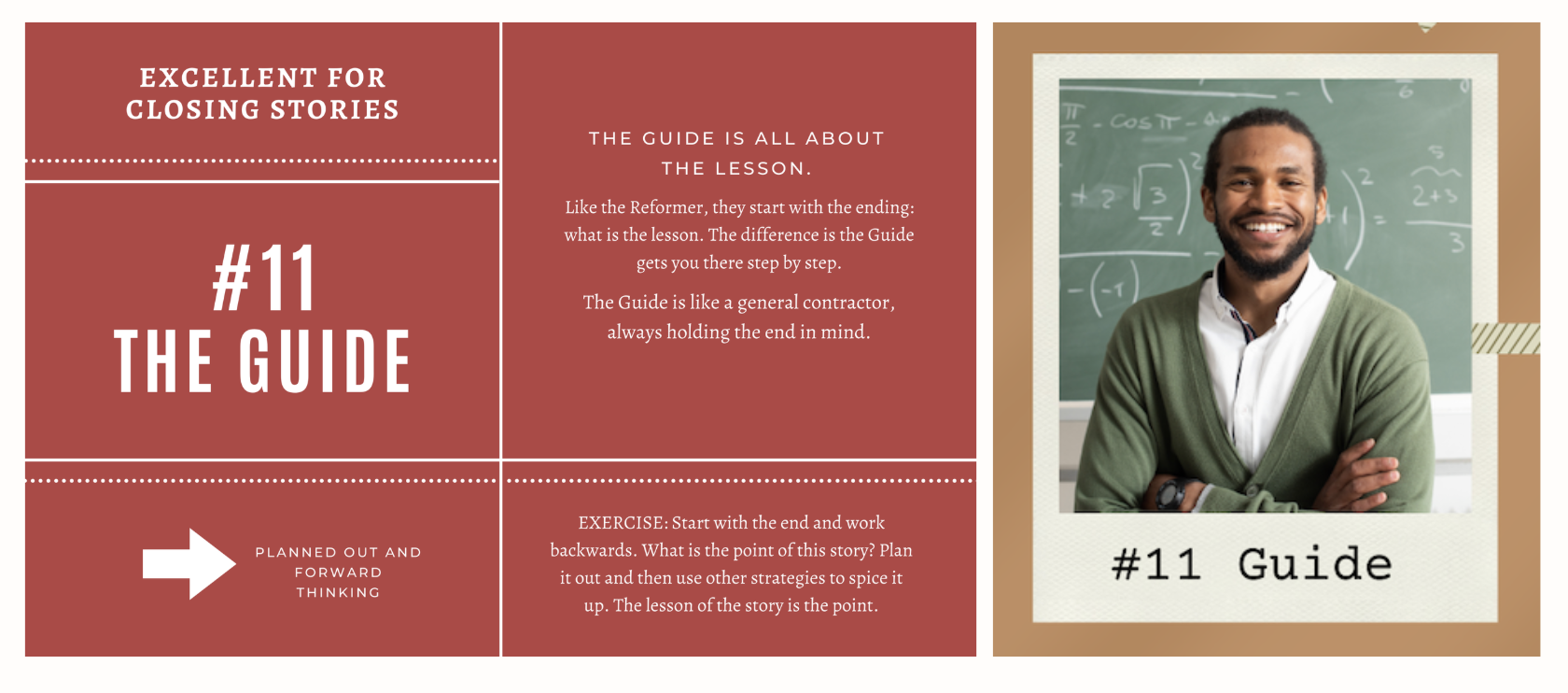
The Guide is the classic sage/teacher/guru approach to storytelling: know where you want to go and then map out how you get there.
Using the Guide approach is hard work, yes—but when a story goes to plan, and the desired result is achieved, it is uniquely satisfying. It is a powerful validation that this storytelling stuff really works.
The Guide uses strategy to dance with chaos and then reach a desired goal.
The Guide is like a coach: make a plan, and be ready to adjust. Guide’s create a tree-like protocol that will consider surprises, and use the chaos around them to land a specific result. A good ending comes when everything else has lined up. Tell the truth and close it.
Their use of strategy is big league. This is the stuff of parables and fables and generally one does not stumble into using the Guide. With this strategy you need to know why you are telling the story and then make sure it delivers.
Too much control, however, doesn’t work.
Being rigid with the plan is often too overbearing (and boring), so using other approaches is always a wise move. The Guide requires a balance of big picture follow-through and a willingness to discover deeper truths along the way. Humility seems to be key when using the Guide, otherwise you start manipulating people out of power rather than serving them with guidance.
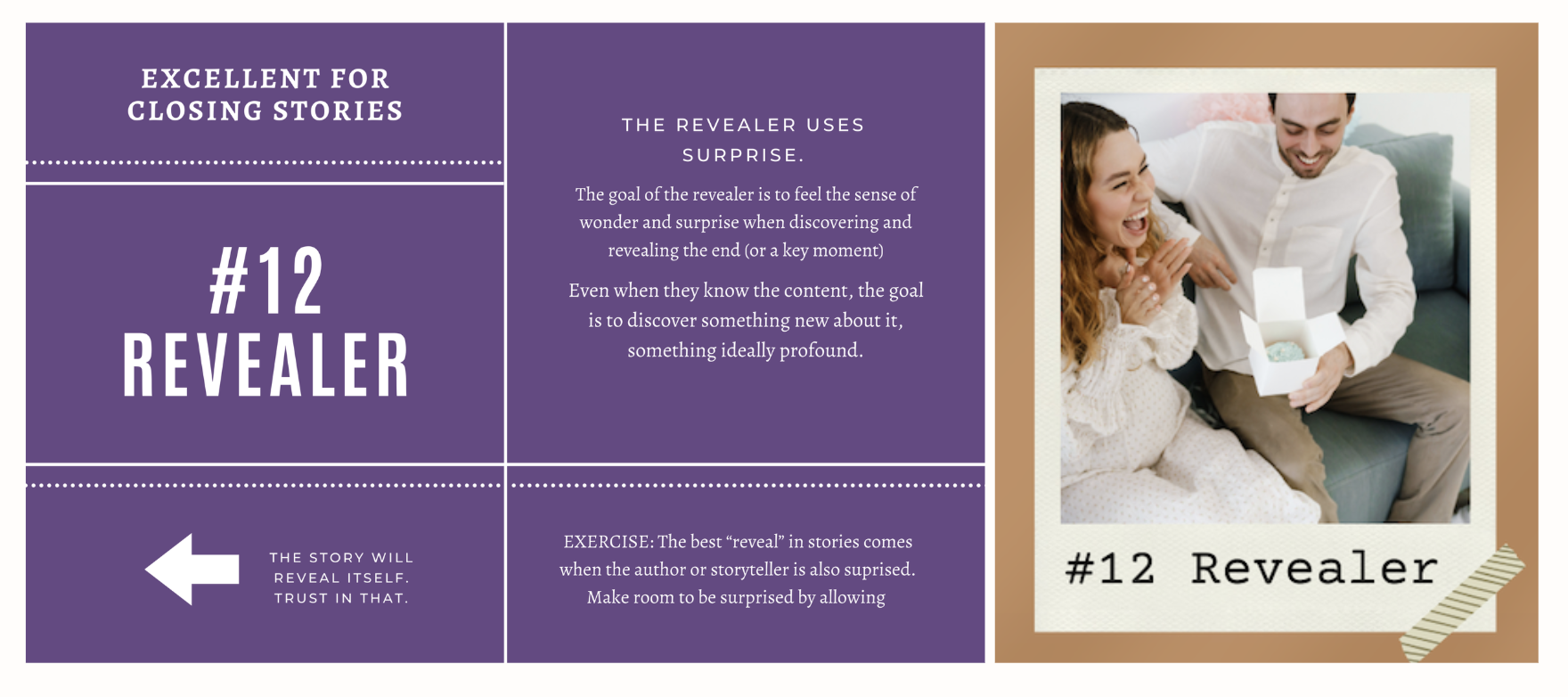
Epiphany is the game of the Revealer.
Surprise, revelation, aha moments are all in the wheelhouse of this storytelling type. And the most important aspect of this strategy is that it is a revelation to the storyteller, just as much as a revelation to the listener. It is essential that the storyteller be surprised. This is what makes the strategy so powerful.
Otherwise the audience feels duped. They feel manipulated.
But here’s the thing:
A storyteller can effectively use the Revealer strategy even when they actually do know the ending.
It still works when they have crafted an epic reveal in advance, but then the storyteller needs to create a sense of mystery and wonder and surprise for themselves as well as the listener. In other words, they need to pretend they don’t know the ending. And this is done with the body, rather than mind.
This is how the Revealer is different from the Guide. The Guide knows full well how this is going to end—according to the plan. The Revealer has an intention and then lets go. You set your intention, pay attention to what is happening, and then let the story work it out.
My hope in describing each of these storytelling strategies is for you to notice which ones feel like home, feel natural to you, and then which ones inspire you. Likely there will only be three or four strategies that fit that description. My encouragement is to start there and practice only those strategies. Consciously intend to leverage those strategies as you tell stories, using them in combination and at different times.
When you reach proficiency, then consider adding a new strategy on the list, or create your own list.
The goal is to tell more stories, and in my experience, enjoying the process is key.
Join a community of Storytellers and receive lots of free tools and courses. I'd love to meet you!
