Four Easy Ways to Start Your Story
Mar 23, 2026
You need to tell more stories.
This is the case with everyone because storytelling is in the same category as fresh air, clean water, nutrient food, and rest: we need stories. We need to tell them and we need to hear them.
The reality is that we tell and listen to stories all day, but the stories we tell and listen to are often scattered, reactive, and meandering because life is a lot right now. We tell ourselves and others stories about our worries, our frustrations, how we think people should behave, what we think governments, businesses, and schools should do. We have opinions and “takes” but we generally don’t realize that we create something every time we say something out loud. We story things into existence. We speak ourselves and the world into being.
Let’s not go down the rabbit hole of fault and consequence or fate—the goal is to tell more nourishing stories, not to judge anyone’s choices. This post gives you ways in which you can begin to leverage storytelling to help your children, your students, your colleagues, as well as yourself. You will story the life you wish into being.
Here is a video about how you start a story.
Many people don’t tell stories because they aren’t sure how to start. The importance of a “good start” is, in my opinion, a fallacy, but it is a powerful fallacy that many people believe, so let’s give you the tools to start well.
These four starting strategies are a part of a grid of twelve storytelling “types”.

In Restorative Storytelling, we are always aware of our bodies and our somatic response to what is happening around us. The science behind prioritizing somatic awareness has to do with upwards of 11 million bits of information being taken in every second, while we are only conscious of 30-40 bits. The overwhelming majority of the information intake is done subconsciously, and therefore won’t be accessed consciously. Restorative Storytellers access information about the listener, our environment, and ourselves through our subconscious minds and bodies. We notice and interrogate sensations, sudden images, mood changes, spikes or dips in energy, and we factor them into our storytelling. We trust that this information is important, even if we don’t consciously “understand it”.
All twelve strategies can work for starting, maintaining and closing a story, but these are organized according to my preferences. I have found that the architect, the tender, the artist, and the reformer are my go-to strategies for starting a story. They work very well for me. I have also calibrated those same strategies for other parts of the story, when it seemed like they would be effective or interesting to me. Per usual, adapt these strategies as you see fit.
Let’s start with the “Architect” storytelling strategy.
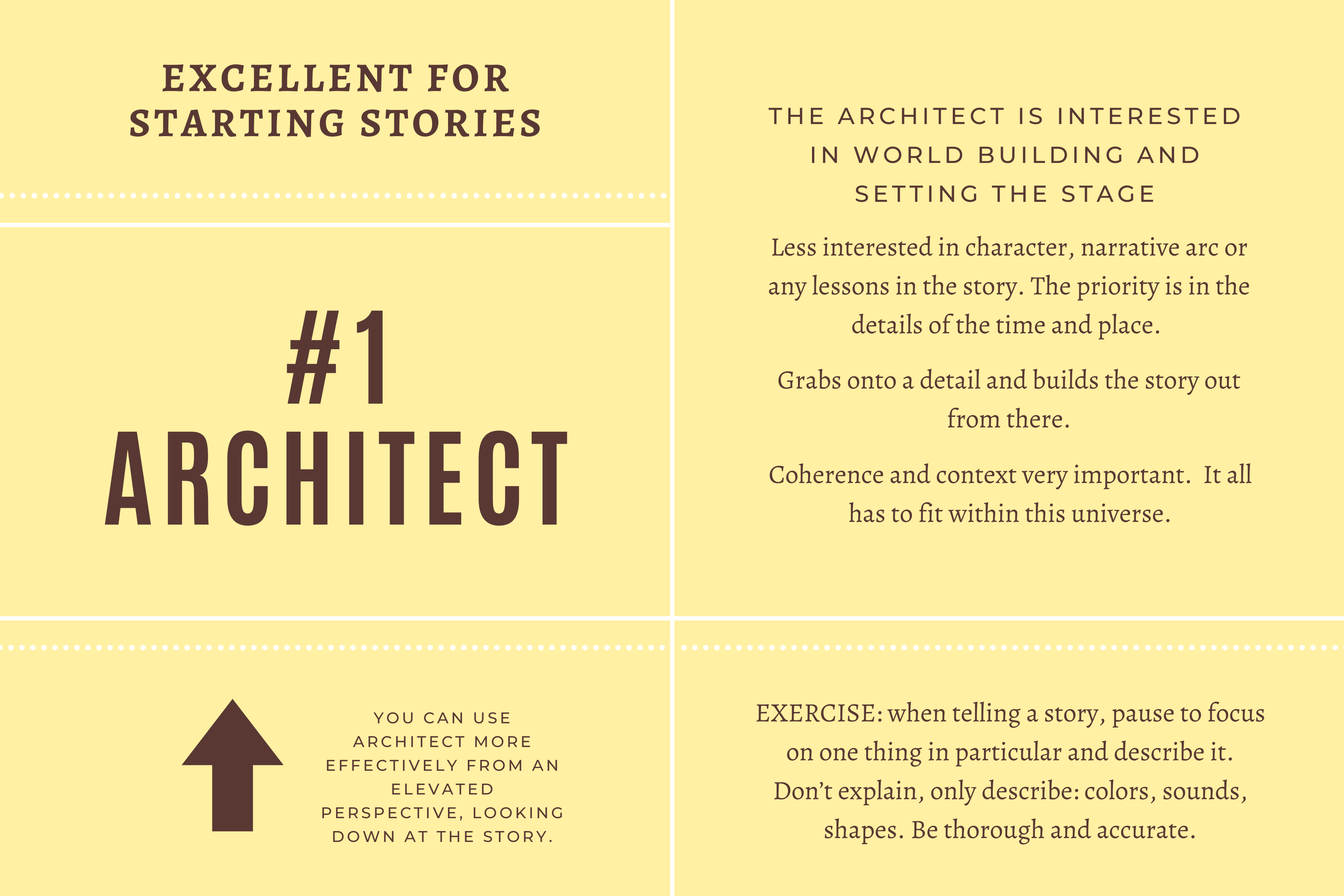
The architect is the strategy employed by all science fiction and fantasy writers—the “world building” approach where you describe the universe in which the story is set.
The architect creates a little distance from the story and describes with objectivity. The point of this strategy is description, and what a wonderful way to start a story: describing where and when the story is taking place.
When you describe something, you are in your brain.
You think about the best words to use and how to best impart what your imagination is seeing. The feeling strategies are more connected to the body, the will strategies are more connected to action and the formal types are more connected to the “big picture”. Architects like the facts, and can rest comfortably with taking their time describing the environment, appearance, and context of the story.
Here is an exercise you can use to access your inner-architect.
Stand up.
Feel your body get lighter.
Without moving, feel like your body can float.
Close your eyes and imagine that you are indeed floating up into the air.
Imagine you are high in the air and able to see, hear, smell everything with perfect clarity.
Open your eyes and look around your environment. Listen and see how many different sounds you can hear. Smell and see if you can distinguish a particular scent. Notice colors, shapes and forms around you without getting lost in the stories associated with them.
Now describe something that caught your attention in detail. Don’t worry about a character or a narrative or anything other than describing something. It doesn’t matter what you describe, just give it your full attention.
This is how the Architect tells a story. They narrow their focus to get all the details “right” so that later, they can cohere with the rest of the story. Use architect when you want to set the stage or go deep into the ambiance or mood. What do you see? What do you hear? What is it like? Let go of all the rest and immerse yourself in the concrete.
The “tender” starts a story with empathy.
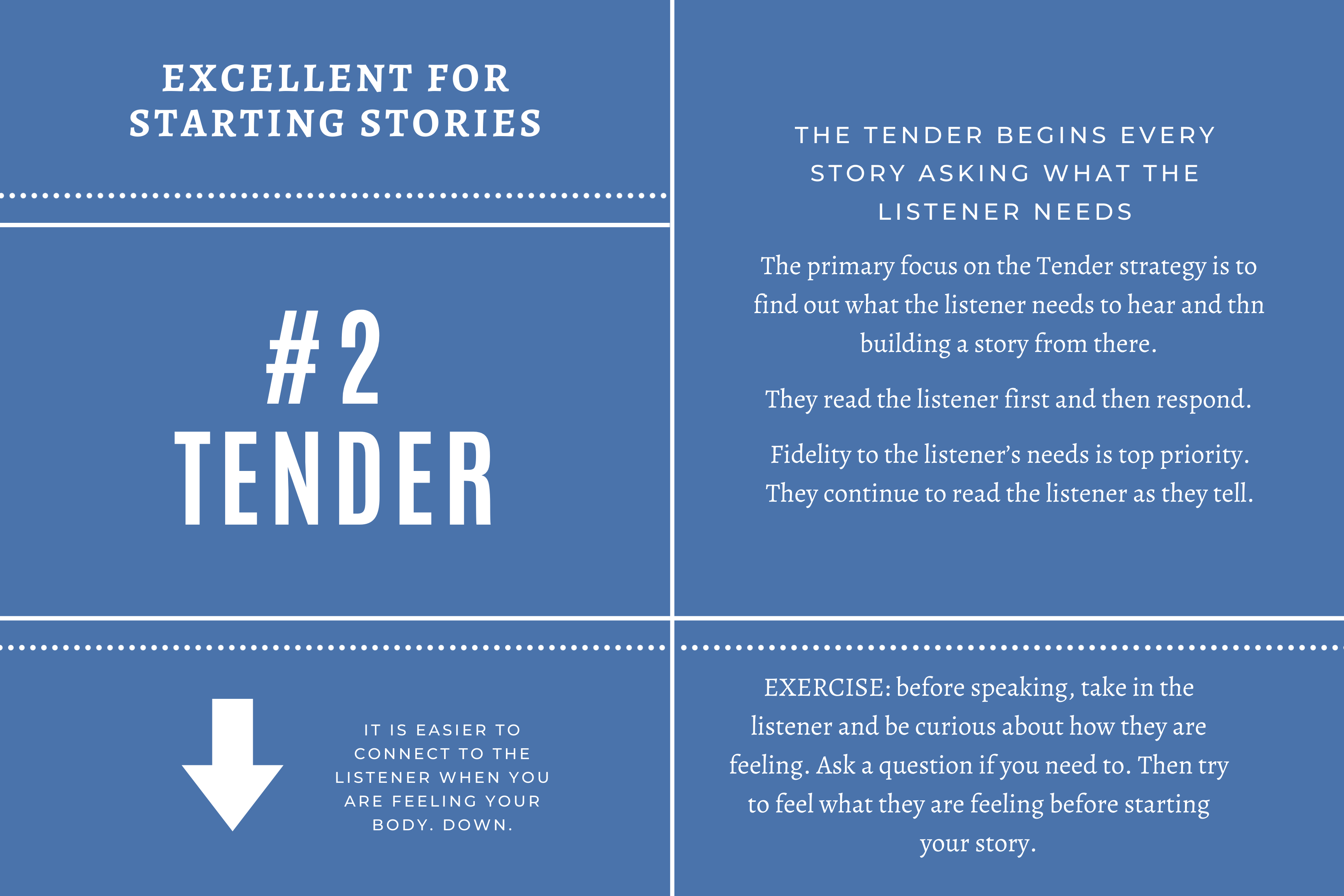
This storytelling strategy is more interested in the connection to the listener. It begins the story by wondering what the listener needs, and answering that question is how the story starts.
This is the feeling strategy that prioritizes somatic awareness. The 11 million bits of information referenced above are stored in the subconscious, and the subconscious often expresses itself through the body. The storyteller’s body then becomes a barometer for the listener’s state of being. The quality of the story, and the skill of the telling are far less important than the authentic connection with the listener and hope to be of service.
That level of empathy is accessed through somatic awareness.
To experience the tender strategy, imagine your body sinking into the earth. Feel your body get heavy, and with your imagination, feel your feet sink into the Earth. You feel like a tree, rooting down down down. You can feel the weight of your bones and you feel completely grounded and immovable. You can feel the soil, the other trees, and the earth around you.
This sensitivity is where the tender lives, and trusting in the sensations is central to building a connection with the listener. Just tell yourself that your instincts or gut feelings are correct and that you can trust them.
The tender asks questions, “How are you?” and then they pay attention to how they feel and what they notice. They listen not only to the words but the facial expressions, the body language, the tone and most importantly, Tenders listen to their own intuition about what is “really going on” for the listener.
The tender trusts what the quiet voice in their head is telling them. They don’t press on with the plan. For a Tender, changing the plan is the plan. It brings them one step closer to their listener. And that is the entire point.
The “artist” storytelling strategy wants to create something beautiful.
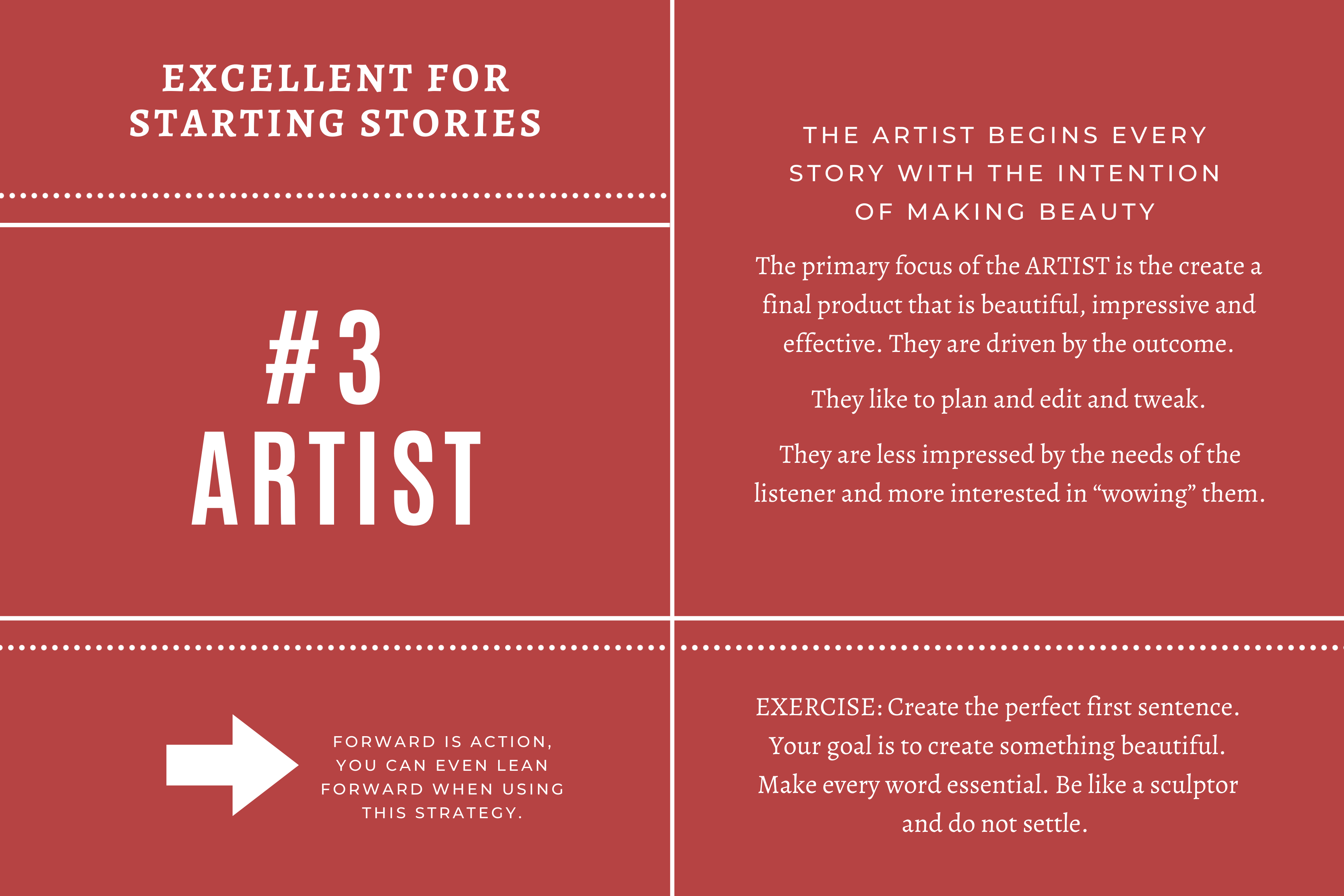
While the architect begins through world building, the tender begins by asking “What do you need?” The artist, however, begins with the intention to create something unique and noteworthy.
They want it crafted well, told well and for it to make a lasting impression. They are not against being empathetic or intuitive or useful or prophetic—so long as it is a part of something really well made. They are craftspeople first. All the rest is gravy. They can employ other strategies and types but in the end, they want something great. They want something memorable and they want people to say, “That was a really good story.”
Of all twelve, it is the one that most resembles an entertainer. Artists prepare. They craft. They practice. They tinker and rehearse. They are probably the least interested in the listener’s needs and serving those needs with the one exception: if the listener’s needs and serving those needs is a part of their artistic vision. Tenders do this authentically. Artists do it as a part of their craft.
To practice the artist strategy, attempt a perfect opening line.
Set the intention for the story. Is this a bedtime story? A lesson? Something for the camp fire? It doesn’t matter, but the first step is to make up a story off the top of your head. Blunder your way through the story as best you can, knowing no one is listening to you.
When you are finished, choose a part of the spontaneous story that might have promise. What part of the story was actually pretty good? What little section of the story sounded right, or made you feel a little excited or invested? Choose that part of the story.
This is where you begin your story. Craft the perfect opening line starting the story at your chosen point. Don’t make it too long and be very choosy with your words. Try to get it just right. Be brief and nail it. Make this opening line sound great.
The last of the four starting strategies is interested in the form of the story.
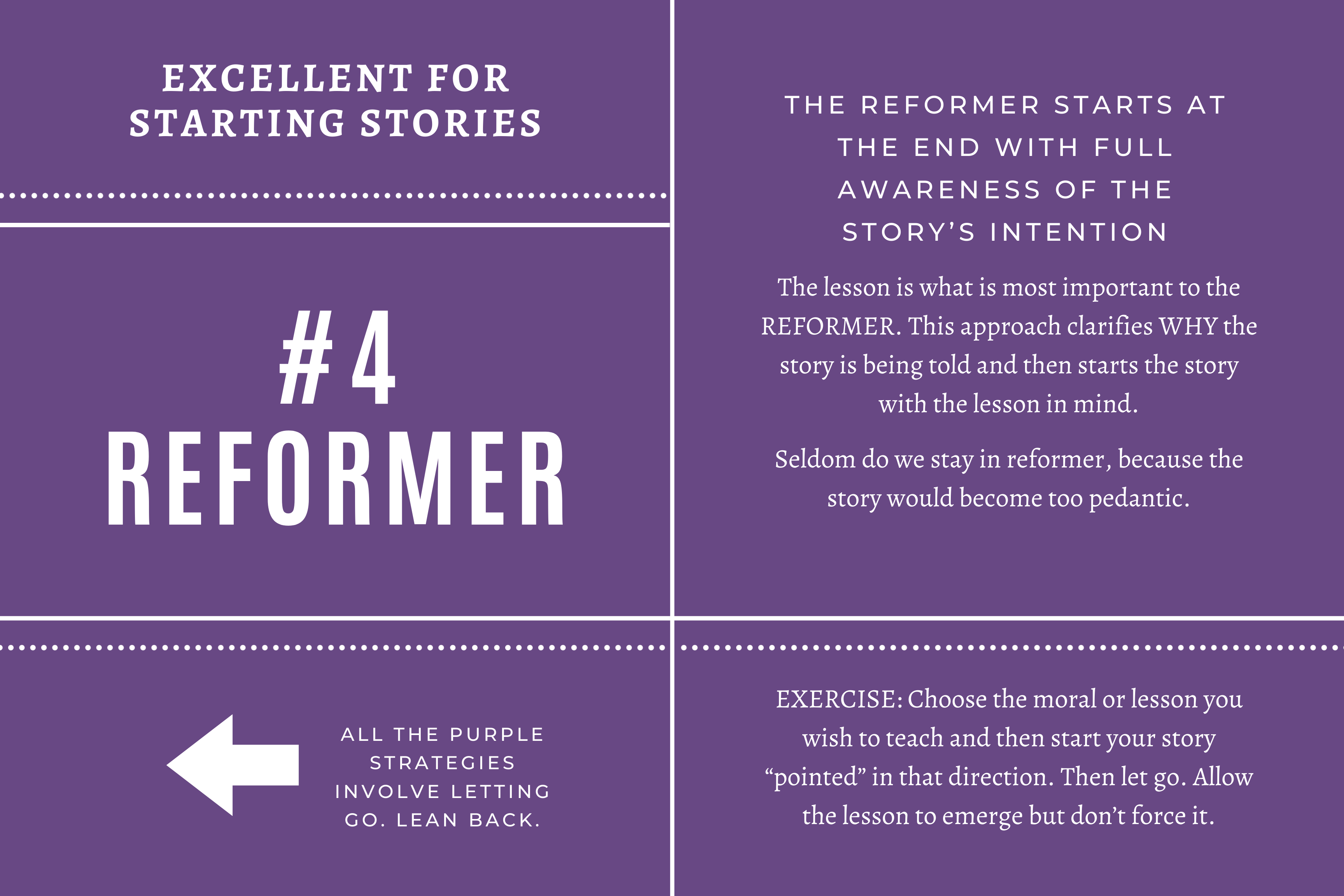
The “reformer” asks the big questions: what is the point? Why tell a story at all? Who does this serve and when will it serve them? They are most interested in the lesson or impulse that the story will bring. They wish to bring change to the listener, to improve their life by way of a story. So before these storytellers open their mouths, they get clear on the intention first.
The reformer begins by setting the intention and then letting go.
Pick something that you want to teach. Pick a reason for the story. Answer the question: why are you telling this story. Name it clearly.
Jump to the beginning and quickly determine a possible way to begin a story that will land that lesson. You don’t want to deliver the lesson up front, but you want to set the stage for that lesson. We are not teaching in the beginning, we are merely preparing for the lesson.
The reformer type is not picky about how the story begins, so long as it is aiming in the right direction. Thus the storyteller aims the story toward the lesson and then lets go.
Reformers let go because they don’t want to get pedantic and hit the listener over the head with the lesson. If the lesson is too obvious, the listener will nod and say to themselves, “Oh I see where this is going” and stop listening. And they are right to do so. They got it. Why listen further?
Instead, it is best to surprise yourself as a storyteller.
If you let go a little and allow the story to wander a bit, you might find something new and interesting. And your interest will be transferred to the listener. They will sense something new and emergent and even a little risky. This will engage them. This will keep them in attention.
But we are getting ahead of ourselves. The reformer, as well as the artist, tender, and architect, are here to help us quit our hesitancy and begin the story. What happens next is not the issue. Starting is everything.
So choose one of the four and try it. Tell yourself a story or take the leap and try the approach on someone else. They will benefit from it!
Join a community of Storytellers and receive lots of free tools and courses. I'd love to meet you!
